
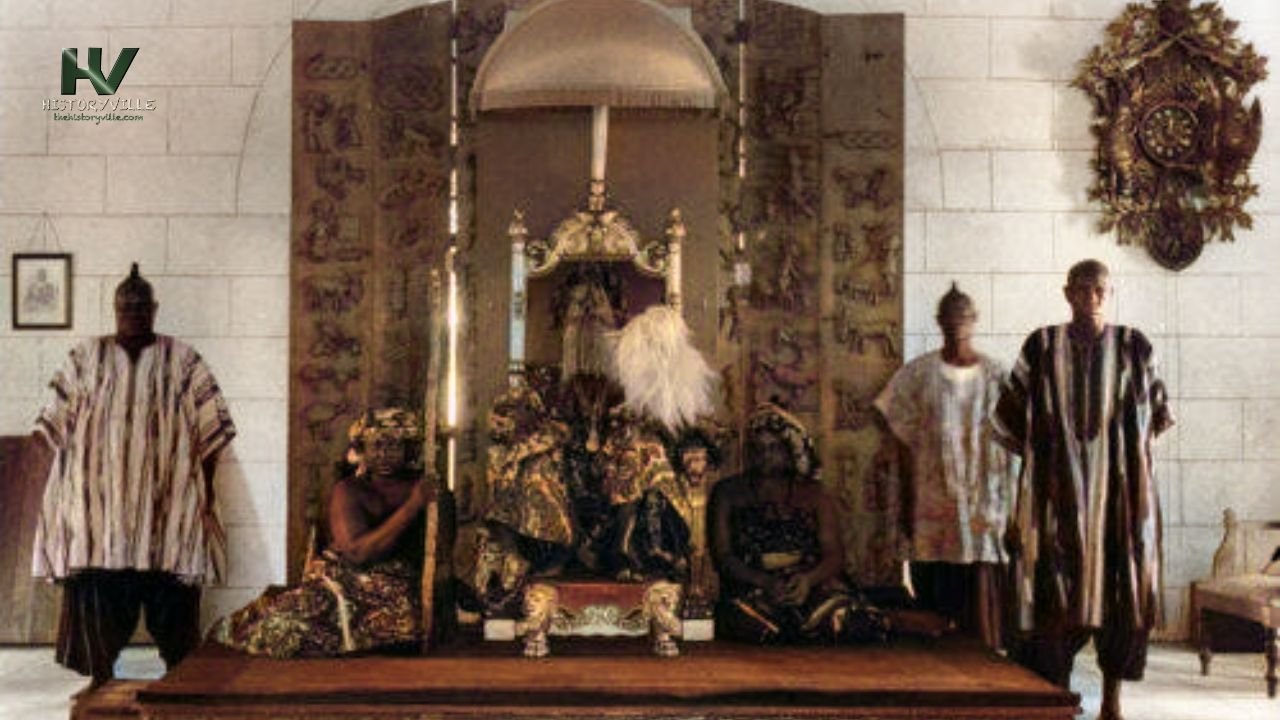

The Kanem-Bornu Empire, the Oyo of Yorubaland, Benin and the Sokoto Caliphate were known for having a central ruling system. This specific structural feature is why these kingdoms are referred to as centralised states in Nigerian historical representation.
These once powerful kingdoms, with their institutional dynamics and centralised empires, gradually declined in influence until they were eventually made ruins by the British colonisation of Nigeria.
So, what exactly were centralised states in pre-colonial Nigeria, and how did they lose their influence and power?
What are Centralised States?
To put it simply, Centralised States, as the name implies, are states with a central ruling or governing authority. While this definition does not sufficiently explain what centralised states are, it describes the most important representative characteristic of the subject and the first feature that will be discussed in this narration.
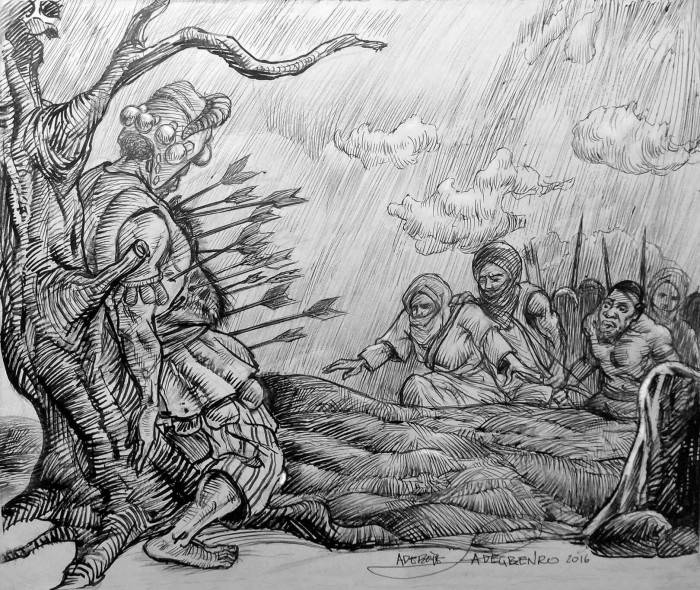
A state refers to a political entity that is formed through human associations. Contrary to its popular use in modern times. For example, in Nigeria, where they are political units subject to a federal government, states are expected to be autonomous and self-governing.
This particular definition will be adopted throughout this narration as it applies to the kingdoms and empires being discussed. On a more in-depth look, it might as well apply to the majority of societies in pre-colonial Nigeria. Since Nigeria, as it is known today, was a home to separate and autonomous ethnic entities before the colonisation and amalgamation, it is right then to categorise those entities as states.
Centralised states are primarily characterised by a central ruling authority, which implies that the control of the state is vested in a single authoritative body. This, however, does not equate to an absolute power system. In other words, centralised rulers are indeed authoritative but not necessarily autocratic.
As the background knowledge of states and centralised states has been established, it is at this juncture that we move to explore some specific examples of centralised states in precolonial Nigeria, their features, and the effect of British colonisation on their social and political organisation.
The Kanuris and the Centralised State of Kanem-Bornu
The modern-day Kanuri is said to have been established in the late 14th century. However, as far as history goes, this ethnic group of people found their roots in the ancient Kanem-Borno dynasty. Admittedly, the origin of the Kanuri is tricky to define, but the etymology of the name – “Ka” meaning “stick” and “Nuri” meaning light, suggests that the group are a pastoral set, who are most likely immigrants from neighbouring borders of Lake Chad.
In the same way, even the origins of Kanem-Bornu itself are unclear. However, the influential dynasty is dated to have come into existence in the 8th century AD. It spreads across regions in today’s Niger, Cameroon, and Nigeria. The first significant feature of the empire in history was when the Kanem kingdom was established in the southern regions of present-day Chad. This particular kingdom lasted for hundreds of years, from the 9th century to the late 14th century, before it experienced its first fall and merged with the kingdom in Borno.
Perhaps, it was at this time that the Kanuri gained visibility as the Kingdom’s representative group because history highlights this era to be one where the Kanuri language was adopted as the general language of the Kanem-Bornu Empire.
The Kanem-Bornu Empire
Like many indigenous empires of its time, Kanem-Bornu engaged in monarchy. In this system, power was centralised, that is, controlled by the kings referred to as “Mais.” In situations where a royal member was not the Mai, they were members of the 12-man administrative council that governed the empire alongside the Mai.
The first notable king of the empire is Saif ibn. Saif brought about the era of the Sayfawas – a series of Kanuri Islamic kings who ruled over the Empire.
Decline of the Kanem-Bornu Empire
It is a known fact that empires rise and fall. The fall of the Kanem-Bornu empire started with its decline, which worsened in the 19th century. Internal conflicts, perhaps unavoidable, as well as economic crises, raged in Borno where the Mai, now called Shehu, Ashimi, reigned.
The last straw that broke the camel’s back was Rabih Fadlallah, who set his eyes on the failing empire. Perhaps this is a valid response for such times when different groups were being claimed and absorbed. Is it such a surprise, then, that these leaders sought to take an empire with a grounded history such as Borno?
In 1893, Rabih’s army defeated Ashimi’s, and he successfully invaded Borno, despite the resistance put up. Subsequently, the French army of the European colonists defeated Rabih, and Borno fell under their command. However, as was a common audacious habit of colonists during that era, the British and the French disputed over who had the right to the territory of Borno. Federick Lugard, who was governor of the northern protectorate at that time, took up the matter, and ultimately, the British Occupation of Borno was concluded in 1902.
British Colonisation and its Influence on the Kanuris
From the ashes of the thousand-year-old Kanem-Bornu Empire rose the Borno emirate during the colonial period. Amongst many other things, the Indirect Rule introduced during this colonial period changed the political system that had long been practised by the Kanuri. No longer were they the centralised power; rather, they were at most mouthpieces for the colonial authority.
However, the Indirect Rule retained the traditional structures adopted by the people. For instance, the Shehu of Borno state is still descended from the Kanuri and functions as both a political and religious leader of the state.
In Nigeria today, the Kanuri presently make up the fifth-largest ethnic group. According to the 1952 census, there were about 1.5 million Kanuris in Nigeria. By 1963, this figure had risen to approximately 4.8 million, contributing to 15 per cent of the northern population of Nigeria at that time.
The Centralised State of the Oyo Empire
The Yoruba are one of the three major ethnic groups in Nigeria, with a long history of existence and expectedly vague stories of origin. The origin of the Yorubas, according to legends, is that a certain king of Mecca– Lamurudu escaped and found his way to Ile-Ife. There he had their offspring, one of whom was Oduduwa, the father of the Yorubas.
Other tales, especially ones inspired by Yoruba spirituality or traditional religion, depict Oduduwa as a divine being who was sent directly by Olodumare (God) to establish the human race. By so doing, Oduduwa became the first ruler, the Oòni of Ifè, and by implication, the progenitor of all human life. While it is true that these are simply tales, a consistent detail in almost every version retold is the city of Ilé-Ifè.
Historically, Yorubaland is known to have many entities under its umbrella, some of which make up the significant kingdoms found in precolonial West Africa. Primarily, the Yoruba state kingdoms that existed in the precolonial days are Ile-Ife, Oyo, Ijebu and the like.
Interestingly, although these kingdoms are grouped as “Yoruba lands” now, only the Oyo people were described as such in old times. It was not until the 19th century that “Yoruba” was used as an encompassing term as it is today.
The three major kingdoms mentioned above all share similarities in their shared origin.
Ile-Ife
Ile-Ife is said to be the oldest kingdom in Yoruba history. Although different accounts claim different periods for its origination, a common consensus amongst historians is that the rise in popularity started around the 10th and 11th centuries. The rationale for this opinion is rooted in the Ife arts, that is, traditional crafts, artwork, and relics in Ile-Ife, and found to be dated to such a time.
For over four centuries, Ile-Ife rose in affluence through the commodification of its sophisticated arts. This lasted roughly from 1000 AD to 1500 AD. Furthermore, as the first of its kind in Yorubaland, the organisation of Ile-Ife’s government inspired a similar trend in its contemporary Yoruba States.
Each Yoruba state had its Oba, that is, a king, on whom the state authority is vested. But the states seemingly got creative with their expressions of kingly terms. For instance, for the Ife Kingdom, the king is called the Ooni, while the King of the Oyo Kingdom is referred to as the Alaafin. Similarly, along with the Kings, there is usually a Council, which may function in either administrative or advisory roles for the King and the Kingdom.
While Ife is undoubtedly a relevant kingdom to the history of the Yorubas and Nigeria as a whole, the Kingdom of Oyo is more relevant to this discourse on centralised states.
Oyo
Taking over from its predecessor, the kingdom of Oyo is said to have been formed around the 14th century, the period in which Ile-Ife was in decline. As trade routes began to shift, the city-state of Oyo started to eclipse Ile-Ife in terms of prestige and power.
The Oyo kingdom peaked around the 17th and 18th centuries as it became an empire and extended into the transatlantic coasts through trading. Some authors named the military power possessed by the Oyo Empire as a factor that spurred its growth. A significant example of this is the empire subduing the western kingdom of Dahomey in 1730 and 1748, respectively.
Arguably one of the largest empires in precolonial West Africa, Oyo was the centre of Yorubaland affairs during its peak. The empire grew to be the dominant and representative empire of the Yorubas, although Ife still had all the religious respect.
Decline of the Oyo Empire
The organised structure of the Oyo Kingdom is quite fascinating. As a centralised state, the empire was headed by a ruler called the Alaafin of Oyo. The administrative body that works with the Alaafin to centrally manage the empire is a cohesive body. They include the Council of Chiefs performing advisory roles to the Alaafin, the Oyomesi, a group of seven chiefs who are responsible for crowning a king, and the Baale (village head chiefs), amongst others.
As is perhaps the fate of every empire, internal power struggles raged in Oyo. This led to a series of infighting amongst the empire’s vassal states. The trading coasts which funded the empire’s economy were being lost. As if that were not enough, the Fulani had also invaded Ilorin, Oyo’s prominent horse supplier for their cavalry.
By the early 1800s, the powerful kingdom of Oyo was on the brink of collapse from the strains of both internal and external tussling. In 1835, the Fulani invaded Oyo, sacked the capital and killed the Alaafin, Oluewu. Many historical sources cite the year 1835–1837 as the official period when the Oyo empire finally fell.
Colonial Influence on the Centralised Yoruba States
It was during this vulnerable period that the British colonists “intervened” and declared Oyo and the neighbouring Yoruba lands a protectorate in 1893.
It cannot be outrightly said that the colonisation affected the Oyo Empire, seeing that the empire had collapsed before the colonisation. However, the contrary is the case for Yorubaland in its entirety.
One major consequence of British colonialism on the Yoruba lands is the relinquishing of their rulers from political leaders to simple cultural and spiritual leaders.
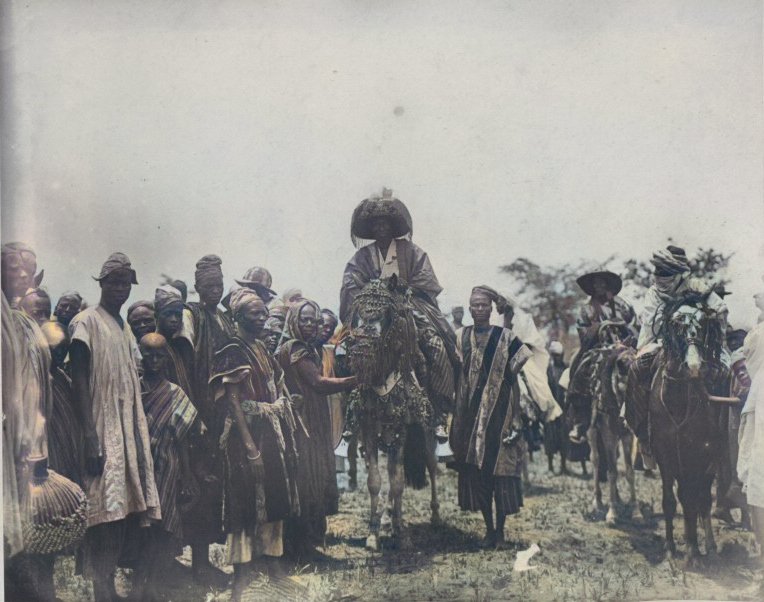
In present-day Nigeria, Oyo is a state in the Southwestern region of Nigeria. To distinguish the Empire of old from the state of Oyo, historians refer to it as New Oyo. The cultural leader of Oyo is still known as the Alaafin even today, serving as a remembrance of the old Oyo Empire.
The Hausa City-States
Like other indigenous pre-colonial states that have been discussed, the exact origins of the Hausa are hard to place. Even though some accounts suggest its existence dates back to the ninth century, there are more mythical tales than historical facts to support the claim.
Commonly in literature, the Hausas are said to hail from the Baghdad prince, Bayajidda, who is seen as the father of the Hausas. The tales, rooted in their imaginative background, glorify Bayajidda as the hero who saved a town from a snake and then settled there to marry their queen. The sons of Bayajidda then apparently formed the seven Hausa city-states.
Historically, Hausaland has been proven to comprise different states existing as independent entities in the large landscape. These include present-day Kastina, Kano, Gobir, Zaria, Daura, Zamfara, and Kebbi, amongst others.
These cities were spread across lands in the four cardinal points, touching the Air mountains in the North, Jos in the south, Borno in the east and the Niger valley in the west. While smaller ethnic tribes were present in the Hausalands, the major lingua franca was Hausa.
Features of the Centralised Hausaland
The Hausalands were led by a king, called the Sarkin. Since each city-state was independent and existed in small, close-knit communities, decisions were hardly centralised. It was not until 1804, when Uthman Dan Fodio conquered Hausa land through his Jihad wars, that the centralised ruling system started to come into play.
The Caliphate founded by Dan Fodio is admittedly the first organised attempt to unite the different city-states in Hausaland. Appropriately, this requires a centralised government. To achieve this, Dan Fodio divided the states into Western and Eastern Caliphates, each headed by an Emir. The Caliphates were further broken down into Emirates.
With this structure, Dan Fodio maintained a centralised government in which the decision-making was spearheaded by the Emirs and other chosen officials, for example, the Waziri, also called the prime minister, the Madaki, who commanded the Emirate/Caliphate Army, and so on.
This structure was upheld in the Caliphate until the advent of the British.
Influence of British Colonialism on Hausaland
In 1903, the Hausa lands were colonised. When this happened, the Caliphate metamorphosed into the “Northern region” of Nigeria as Sir Frederick Lugard merged the eastern and western Sokoto emirates along with neighbouring entities.
Quite similar to the Kanem-Bornu situation, the British colony refrained from disrupting the organisational structure of the caliphate. But the important question to be asked is what use is a “governing structure” that no longer has authority?
The colonial policy put forward by Frederick Lugard may have kept the structures in place, but in practicality, it was void of the centralised politics that characterised the Emirate system created by Dan Fodio. As historians insist, the Indirect rule only served to strengthen the British government and widened the chasm that existed amongst the Hausa cities in the Caliphate.
Today, the Hausa lands, which have long become Northern Nigeria, still occupy the largest landmass in the country. Taking up a spectacular 70 per cent of the country’s total land size, the region is home to 19 out of the 36 states in Nigeria.
Features/Characteristics of Centralised States in Pre-Colonial Nigeria
Centralised states in Nigeria were characterised by strong, hierarchical governance structures that concentrated power in the hands of a central authority. These states, such as the Sokoto Caliphate, Oyo Empire, and Kanem-Bornu, exhibited distinct features that ensured their cohesion and stability.
One of the primary features of centralised states was the presence of a supreme ruler, such as the Sultan in Sokoto, the Alaafin in Oyo, or the Mai in Kanem-Bornu. These rulers exercised extensive authority over their territories, maintaining control through a network of subordinate officials and regional governors.
Another key characteristic was the existence of a well-structured bureaucracy. These states had administrative systems that facilitated governance, taxation, and law enforcement. In the Sokoto Caliphate, for instance, the Emirate system ensured effective control over different regions, while in Oyo, the administration was divided among various chiefs and councils that reported to the Alaafin.
Military strength was also a defining feature of centralised states. A formidable army enabled rulers to expand their territories, suppress revolts, and maintain order. The Oyo Empire, for example, had a powerful cavalry force that played a crucial role in its expansion and defence.
Furthermore, centralised states often had a codified system of laws and justice. These laws were instrumental in maintaining social order and were often influenced by religious or customary traditions. The Sokoto Caliphate, for instance, implemented Sharia law, while Kanem-Bornu had a long tradition of Islamic governance.
Economic stability was another hallmark of centralised states. Trade, taxation, and tribute systems ensured a steady flow of resources to the ruling authority. These states were often key players in trans-Saharan and regional trade, dealing in commodities such as gold, salt, and kola nuts.
Lastly, centralised states typically exhibited a strong cultural and religious influence. Islam played a dominant role in the governance of the Sokoto Caliphate and Kanem-Bornu, while the Oyo Empire maintained traditional Yoruba religious practices, reinforcing the legitimacy of the ruling class.
These features collectively ensured the longevity and influence of centralised states in pre-colonial Nigeria, shaping the political and social structures that persisted even during and after colonial rule.
Your support can make a world of difference in helping us continue to bring Nigeria’s rich history to life! By donating to HistoryVille, you’re directly contributing to the research, production, and storytelling that uncover the incredible stories of our past. Every donation fuels our mission to educate, inspire, and preserve our heritage for future generations.
Please stay connected with us through our social media handles and make sure you are subscribed to our YouTube Channel. Together, let’s keep the stories of Nigeria’s past alive.