


For more than 10 years, Sir Ahmadu Bello, the Sardauna of Sokoto, served as the first and only Premier of the Northern Region of Nigeria. A bold and charismatic leader, the Premier was undoubtedly the most powerful politician in Nigeria’s First Republic.
A founding father of the Northern People’s Congress (NPC), Nigeria’s largest political party at the time, Sir Ahmadu Bello’s love for the North made him focus on the development and progress of the region that now consists of Nigeria’s 19 states and its Federal capital in Abuja. Bello was so powerful that even emirs held him in high regard and dared not challenge his authority, especially after he deposed Emir Muhammadu Sanusi I of Kano in April 1963.
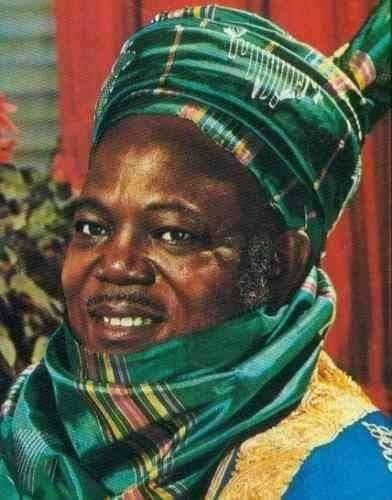
He was a highly respected leader and one who was devoted to the unity of the country. The nation’s political instability after Independence led to the bloody coup of 1966, which saw the Premier brutally murdered, along with his first wife. His death would trigger a series of events, culminating in the nation’s first-ever Civil War.
Political Career
Ahmadu Bello began his political career by seeking the post of Sultan of Sokoto. He was unsuccessful in his bid but was vested with the title of the Sardauna of Sokoto, a title meaning ‘Crown Prince.’ In 1951, he helped establish the Northern People’s Congress (NPC). The party eventually became the largest in the nation at the time.
During this period, other strong parties had risen in the other regions of the country. The National Council of Nigeria and the Cameroons (NCNC), which later became known as the National Convention of Nigerian Citizens, was led by Nnamdi Azikiwe and was dominant in the Eastern Region, and the Action Group Party (AG), led by Chief Obafemi Awolowo, which was dominant in the Western Region.
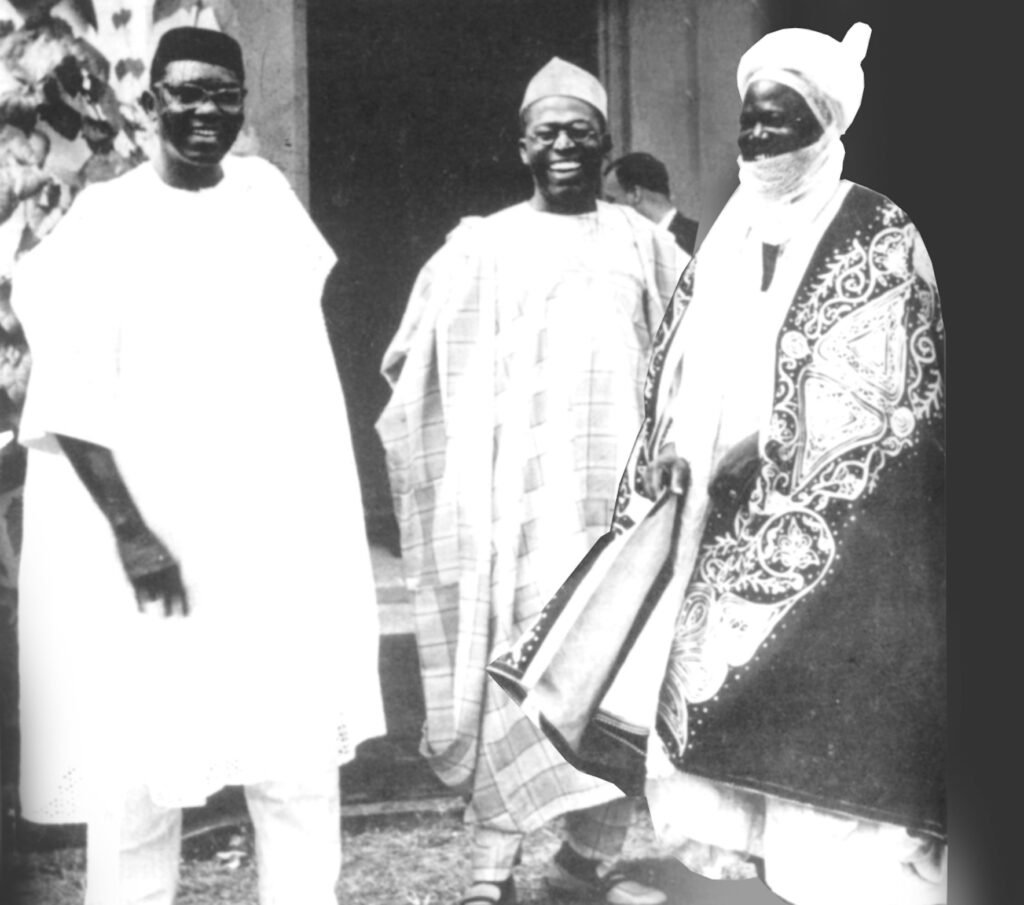
Ahmadu Bello preached the gospel of Federalism as the system of government most suitable for the country. This was, however, mainly because of his desire to protect the North from what was a perceived possibility of Southern domination.
He soon became the head of the NPC. He would go on to become a member of the regional executive council as the Minister of Works. He was also head of various ministries in the Northern Region, including works, local government, and community development.
In 1953 and 1957, he led the Northern delegation to the independence talks held in London.
In 1954, Sir Ahmadu Bello became the first Premier of the Northern Region.
The 1959 General Elections saw his party, the Northern People’s Congress, enter a coalition with Azikiwe-led NCNC. Both parties forged an alliance, and together, they formed Nigeria’s first indigenous federal government. They went on to win the elections with the NPC garnering the majority of the seats in the House of Representatives. Nigeria gained independence from Britain the following year, 1960.
During the first few years after Independence, Ahmadu Bello was, perhaps, the most politically powerful person in the country, even more powerful than Prime Minister Sir Abubakar Tafawa Balewa.
However, Bello never sought leadership over all of Nigeria. He was, in fact, content in his position as Sardauna of Sokoto and the Premier of the Northern Region.
The January Coup and the Assassination of Sir Ahmadu Bello
While Sir Ahmadu Bello served as the Sardauna of Sokoto and Premier of the Northern Region, Sir Abubakar Tafawa Balewa served as the Prime Minister of the nation. The Prime Minister’s administration was, however, met with turbulence, a string of chaotic events and violent protests. All of these marred the Balewa administration. The Western Region had become a shadow of itself as it was replete with bloodshed on a daily basis.
This was as a result of the power tussle between the founder of the Action Group Party, Chief Obafemi Awolowo, and the Premier of the region, Chief Samuel Ladoke Akintola. The supporters of the different factions would not see eye to eye, hence an eruption of violent displays in the region.

Also, there was a treason charge and conviction against Chief Obafemi Awolowo. This led to a series of protests and condemnation from many of his followers.
The inability of the Prime Minister to douse the fire of rage and chaotic displays eventually became his downfall, and also that of Sir Ahmadu Bello and Chief Samuel Ladoke Akintola.
On January 14, 1966, Chief Samuel Ladoke Akintola met with Ahmadu Bello to warn him of rumours of a military overthrow. He warned that they both flee that country. However, the Premier maintained an unflinching stance, asking what would become of the nation if they were to flee. His fearlessness doused the fears of Akintola, who returned to his home that night.
The following day, January 15, 1966, saw Nigeria’s first-ever military coup. Major Kaduna Chukwuma Nzeogwu, in the early hours of the morning, stormed the house of the Premier, Sir Ahmadu Bello, and bombarded it.

After frantically searching for him, he eventually found him in the midst of his wives and children. The Premier wriggled free from his wives, but one of them, Hafsatu, held on to him. But Nzeogwu shot the Premier and his wife dead.
The Major afterwards blew a whistle, signalling an end to the operation. He had killed the Premier, and the mission, on his end, had been successful.
Aftermath
Nigeria’s first military coup of January 15, 1966, saw the death, not only of the Premier, Sir Ahmadu Bello, but also the deaths of Prime Minister Sir Abubakar Tafawa Balewa, Premier of the Western Region, Chief Samuel Ladoke Akintola, and the Minister of Finance, Chief Festus Okotie-Eboh.
The death of Sir Ahmadu Bello was, at its best, untimely, and a huge loss to the nation. The coup would trigger an outbreak of violence, a throng of killings, and massacres, especially of the Igbo people. This string of events eventually resulted in the Nigerian Civil War from July 6, 1967, to January 15, 1970.
Want to understand what really happened during Nigeria’s first military coup? Read A Carnage Before Dawn. It offers a carefully researched, vividly told account of January 15, 1966, through a storytelling style that will keep you glued to the book’s pages.
You can get the e-book here and the paperback here.
Love history? Don’t stop here.
📚 Get deeper insights by purchasing our latest history books.
📢 Join our WhatsApp Channel for exclusive updates and historical facts.
📩 Subscribe to our Newsletter and receive fascinating stories from history (World and African history) directly in your inbox.
🎥 Subscribe to our YouTube channel for engaging documentaries and short history videos.
Stay connected with us on social media for daily history content:
🔵Follow us on Facebook.
📸 Follow us on Instagram.
🐦Follow us on Twitter.
💼 Follow us on LinkedIn.
🎵 Follow us on TikTok.
❤️ Support our work by donating to HistoryVille and help us continue preserving and sharing important historical stories.📢Advertise with HistoryVille to reach a growing audience passionate about history and culture.