
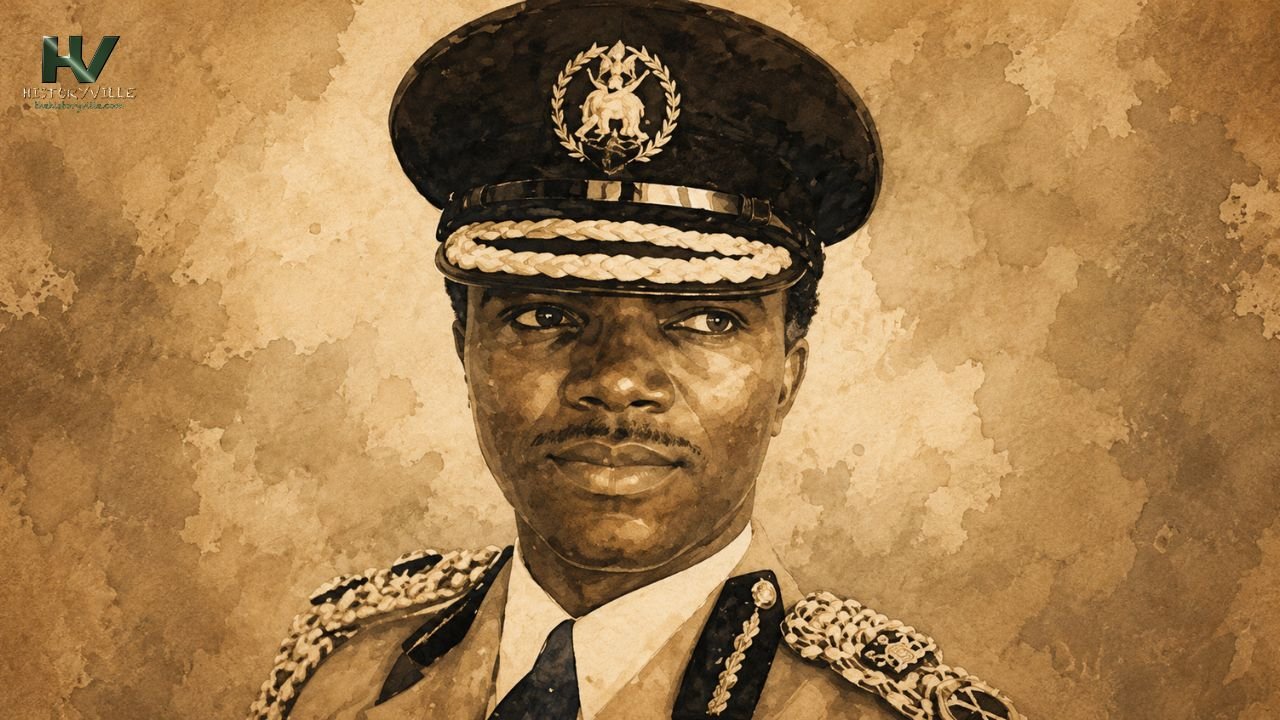

In 1976, Joseph Gomwalk, a Nigerian Commissioner of Police and the first Military Governor of Benue-Plateau State after the creation of states on May 27, 1967, was arrested, screened, tried, and then subsequently acquitted after the charges against him were dismissed.
This was due to his perceived connections to the Buka Suka Dimka’s abortive coup against Nigeria’s 3rd military Head of State, Murtala Muhammed. However, Gomwalk would be arraigned again and retried. This time, he was convicted and executed on this day, 44 years ago.
What really led to Gomwalk’s execution in Lagos is still a subject of debate, even to this day.
Who was Joseph Gomwalk?
Born Joseph Dechi Gomwalk on April 13, 1935, Joseph Gomwalk was a Ngas from Ampang or Pang, present-day Kanke Local Government Area of Plateau State. He attended the prestigious Boys Secondary School, Gindiri, near Jos, where he graduated with distinctions, not just in academics, but also in sports. Gomwalk then proceeded to the University of Ibadan, where he graduated in 1961 with a first-class degree in Zoology.

Joseph Gomwalk then joined the famous Northern Region Civil Service and was made a divisional officer in the Province of Sardauna, but eventually transferred his services to the Federal Ministry of Agriculture, rising to the level of Principal Assistant Secretary by February 1966.
After advanced training at Scotland Yard and the Federal Bureau of Investigation (FBI), he was assigned to the Nigerian Police Force as Chief Superintendent of its elite Special Branch.
Gomwalk and the July 29, 1966, Counter Coup
In July 1966, Gomwalk had got wind of the northern counter-coup that was to reach its apex in Ibadan. As a result, he informed his superior, Joseph Adeola, who was then the Commissioner of Police in Western Nigeria, to alert the Head of State and Supreme Commander, General Johnson Thomas Aguiyi-Ironsi, who was on a visit, and his host, Lieutenant-Colonel Francis Adekunle Fajuyi, of an impending rebellion.
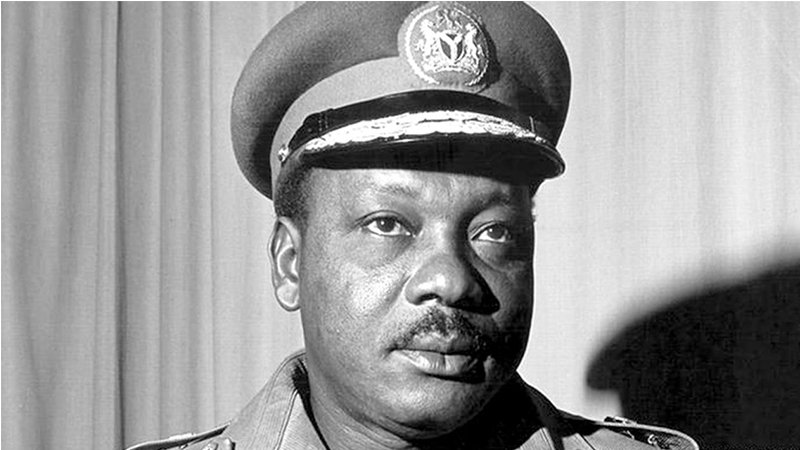
Nigeria’s First Military Head-of-State (January 16, 1966 – July 29, 1966).
The police commissioner would, however, err on the side of caution, as he could not alert Fajuyi and Aguiyi-Ironsi early enough. Five days later, on August 4, 1966, Joseph Gomwalk led a team of policemen to recover the bodies of the now murdered Aguiyi-Ironsi and Fajuyi from a shallow grave near the town of Lalupon, which is on the outskirts of Ibadan.
Joseph Gomwalk as Military Governor
In May 1967, Joseph Gomwalk became a major beneficiary of the very coup that he almost foiled, if not for Adeola’s prevarication. Nevertheless, the new Head of State, Lieutenant-Colonel Yakubu Gowon, who was also his kinsman, appointed him as the military governor of Benue-Plateau State after the regions were broken down into 12 states. The Benue-Plateau State was later broken down into three more states: Benue, Plateau, and Nasarawa, with capitals at Makurdi, Jos, and Lafia, respectively.
Joseph Gomwalk, a visionary leader while governor, started the Nigerian Standard, a government-owned daily newspaper, in 1972. As of 2003, the paper, which was located in Jos, the capital city, had a circulation of around 100,000 copies per day.
After Ahmadu Bello University, Zaria, could not grant Gomwalk’s request to open a satellite campus in Jos, the governor turned to the University of Ibadan, which then opened its Jos campus. It would later metamorphose into the University of Jos in November 1971.
The February 13, 1976, Dimka Coup
On Friday, February 13, 1976, the Head of State, General Murtala Muhammed, was assassinated in an abortive coup while on his way to work. The aftermath of this assassination has generated diverse debates that remain unresolved to date.

For example, the president of the Special Military Tribunal that tried the alleged coup d’état back in 1976, Major-General John Obada, stated in a July 3, 2010, Vanguard newspaper interview that the Lieutenant-Colonel B.S. Dimka coup d’état was “a very complicated thing because it was a coup within a coup.” The General did not provide specifics of “the coup within a coup” but claimed that Dimka was “not ambitious, but motivated by greed and gross indiscipline.”
Arrest and Death
It is as a result of these investigations that Joseph Gomwalk was arrested, screened and tried, and was subsequently acquitted with the charges against him dismissed, only for him to be arraigned again and retried, then convicted under debatable circumstances.
The Obada-led court that tried, discharged and absolved Gomwalk was disbanded. Another military court was formed and headed by Brigadier-General Pius Eremobor, who reversed the acquittal of the former governor and sentenced him to death.
Joseph Gomwalk was executed on May 15, 1976, in Lagos, the federal capital.
Minority officers from the Middle Belt were the scapegoats of the time. The friction between the officers of the Middle Belt and those from the far north resurfaced, and the coup investigation took on the proportions of witch-hunting, and the officers were convicted on the weakest or most circumstantial evidence, mostly relying on Dimka’s uncorroborated testimony.
J.D., as Joseph Gomwalk is still fondly known, is so branded in the memory of his kinsmen, and his supposed presence without the declassification of the court-martial records of 1976 is, at best, circumstantial and will remain in the domain of speculation.
Want to understand what really happened during Nigeria’s first military coup? Read A Carnage Before Dawn. It offers a carefully researched, vividly told account of January 15, 1966, through a storytelling style that will keep you glued to the book’s pages.
You can get the e-book here and the paperback here.
Love history? Don’t stop here.
📚 Get deeper insights by purchasing our latest history books.
📢 Join our WhatsApp Channel for exclusive updates and historical facts.
📩 Subscribe to our Newsletter and receive fascinating stories from history (World and African history) directly in your inbox.
🎥 Subscribe to our YouTube channel for engaging documentaries and short history videos.
Stay connected with us on social media for daily history content:
🔵Follow us on Facebook.
📸 Follow us on Instagram.
🐦Follow us on Twitter.
💼 Follow us on LinkedIn.
🎵 Follow us on TikTok.
❤️ Support our work by donating to HistoryVille and help us continue preserving and sharing important historical stories. 📢Advertise with HistoryVille to reach a growing audience passionate about history and culture.