
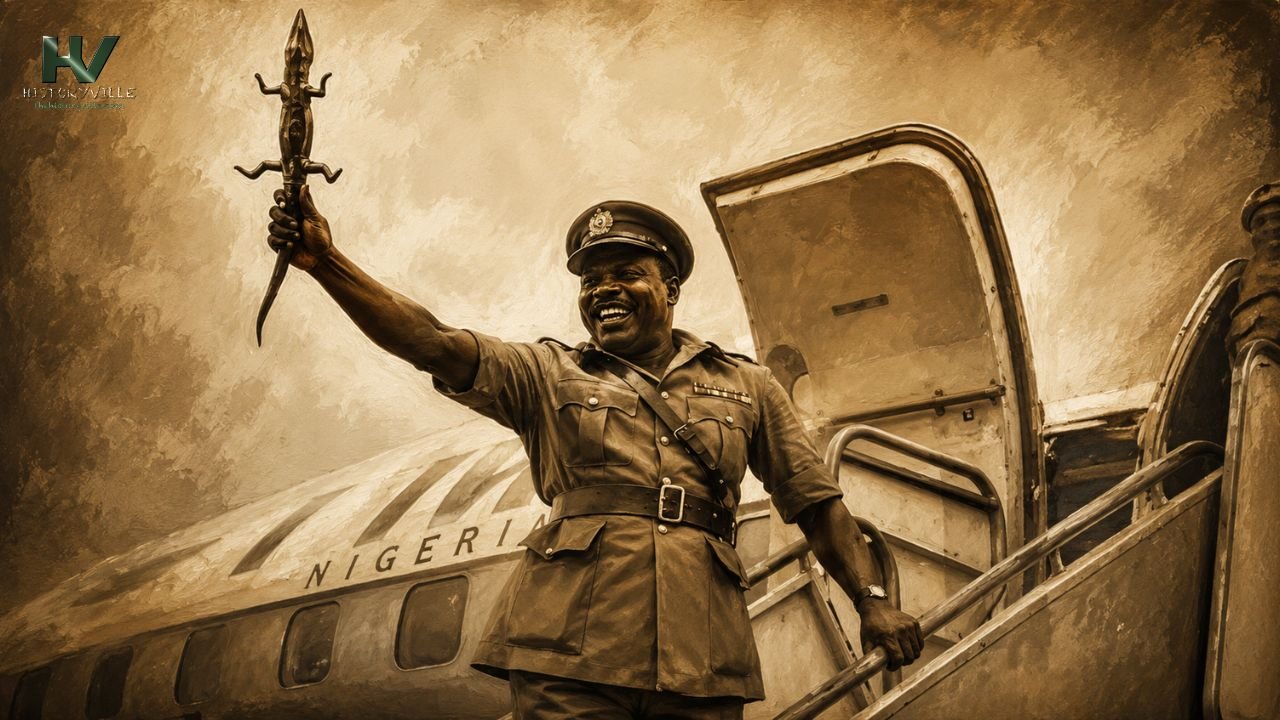

Major-General Johnson Thomas Umunnakwe Aguiyi-Ironsi was Nigeria’s first in many areas: Aide-de-Camp, Head of the Nigerian Army, and Head of State, among many. However, he would go down in history as one who took the rudder of the nation during a military coup that terminated the First Republic.
Today, 03/03 marks an important day in the life of the late General. He would have been 95 today, having been born in 1924 in Umuahia-Ibeku in present-day Abia State.

However, below are some of the interesting facts you did not know about Johnson Aguiyi-Ironsi, Nigeria’s first military Head of State.
Early Life and Education
1. Johnson Aguiyi-Ironsi was born Thomas Umunnakwe Aguiyi-Ironsi to his father, Mazi Ezeugo Aguiyi, on March 3, 1924, in Umuahia-Ibeku, present-day Abia State, Nigeria. He adopted the name “Johnson” as his first name from her elder sister’s husband, Theophilus Johnson, who was a Sierra Leonean diplomat in Umuahia.
2. Aguiyi-Ironsi had his primary and secondary school education in Umuahia and Kano.
Career in the Nigerian Army
3. In 1942, at the age of 18, Aguiyi-Ironsi joined the Nigerian Army against the wishes of his sister, at the rank of a Private with the 7th Battalion. He got promoted in 1946 to the rank of Company Sergeant-Major. Also in 1946, he was sent on an officer training course at Staff College, Camberley, England.
4. On June 12, 1949, after completion of his course at Camberley, he was promoted to Second-Lieutenant of the Royal West African Frontier Force (RWAFF) and soon returned to Nigeria to serve as the Aide-de-Camp to Sir John Macpherson, Governor-General of Nigeria.
5. Aguiyi-Ironsi was promoted to Captain in 1953 and again promoted to Major in 1955. As Major, he served as Queen Elizabeth II’s equerry on her official visit to Nigeria in 1956.
6. In 1960, he became a Lieutenant-Colonel and was subsequently made commandant of the fifth battalion in Kano, Nigeria. Also, in the same year, he headed the Nigerian contingent force of the United Nations Operation in the Congo.
In 1962, he was promoted to the rank of Brigadier-General and, in 1964, he was appointed as the Grand Commandant of the entire United Nations peacekeeping forces in the Congo.
Honours
7. In 1960, the Austrian Government awarded a Gallantry medal to the general and 13 other Nigerian soldiers for their role in the Congo in freeing an Austrian ambulance unit which was arrested and imprisoned by the Congolese authorities because they claimed the unit was a company of Belgian parachutists.
8. In 1965, he was promoted to the rank of Major-General, the same year the British General Officer Commanding (GOC) of the Nigerian Army, Major-General Christopher B. Welby-Everard (1909-1996) handed over his position, making Aguiyi-Ironsi the first Nigerian to head the entire Army on February 9, 1965.
Nigeria’s First Military Head-of-State
9. However, less than a year later, Aguiyi-Ironsi became Nigeria’s first military Head-of-State after a brutal coup led by junior officers of the Nigerian Army on January 15, 1966. To put down the rebellion, Aguiyi-Ironsi seized power and took over as Head of State and Supreme Commander of the Nigerian Armed Forces.

10. Decree 34 of May 24, 1966, promulgated by Aguiyi-Ironsi, caused massive unrest in the Northern part of the country as the Northerners had gone against the delimiting of regional powers as far back as 1959. The decree made the centre strong, thereby abolishing the powers granted to the regions. In July 1966, Aguiyi-Ironsi began a tour of the country (never to return to Lagos) and met with the Northern elite, assuring them of a united Nigeria.
How did Aguiyi-Ironsi die?
11. On July 28, 1966, he was hosted by the military governor of the Western Region, Lt. Col. Francis Adekunle Fajuyi (1926-1966) in Agodi, Ibadan. As he was about to leave for Lagos, Fajuyi coaxed him into spending the night in the Government House.
In the wee hours of July 29, 1966, Northern soldiers led by Major Theophilus Y. Danjuma (b. 1938) came to arrest Ironsi and questioned him about his alleged complicity in the coup which saw the demise of the Sardauna of Sokoto, Ahmadu Bello, and Prime Minister, Abubakar Tafawa Balewa.
The soldiers overpowered Fajuyi and Ironsi and violently stripped off their epaulettes. They were also beaten and rained with blows as they were dragged along to a shallow pit in Lalupon, near Ibadan, where their bodies were riddled with bullets.
Major-General Johnson Thomas Umunnakwe Aguiyi-Ironsi was 41 years, 10 months, and 13 days old when he became the Head of State of Nigeria on January 16, 1966. He spent just 6 months and 13 days in office, the shortest of any military head of state.
12. Aguiyi is an Igbo word which means “crocodile.” Hence, Aguiyi-Ironsi moved about with a crocodile-shaped swagger stick, which many of his soldiers believed was a charm he used to stay invulnerable and alive. The name of his swagger stick was “Charlie.”
13. Aguiyi-Ironsi is the second youngest Nigerian Head-of-State to die in office, after Murtala Muhammed, at the age of 42.
Legacy
14. During his short regime, Aguiyi-Ironsi promulgated a raft of decrees. Among them were the Constitution Suspension and Amendment Decree No.1, which suspended most articles of the Constitution (though he left intact those sections of the Constitution that dealt with fundamental human rights, freedom of expression and conscience were left intact) and the Circulation of Newspaper Decree 2, which removed the restrictions on press freedom put in place by the preceding civilian administration.

15. In 1953, Aguiyi-Ironsi got married to his wife, Victoria and one of their children, Thomas Aguiyi-Ironsi, went on to serve as Nigeria’s Defence Minister on August 30, 2006, under President Olusegun Obasanjo.
16. Major-General Johnson Thomas Umunnakwe Aguiyi-Ironsi was 41 years, 10 months, and 13 days old when he became the Head of State of Nigeria on January 16, 1966. As Head-of-State, Aguiyi-Ironsi spent 194 days in office-the shortest of any military Head-of-State.
17. Aguiyi-Ironsi remains the only Nigerian head of state whose parents outlived him. As of the time of his assassination on July 29, 1966, his father, Mazi Aguiyi Ironsi, and mother, Eguzo, were still alive.
18. Aguiyi-Ironsi was buried three times. First, in a shallow grave, then at a cemetry in Ibadan, and finally, in his hometown on January 20, 1967.
19. On Wednesday, March 28, 2017, the Oyo State government transformed the spot where Aguiyi-Ironsi and Fajuyi were murdered at Lalupon into a memorial park: the Ironsi–Fajuyi Memorial Garden Park. There is a palm tree that still conceals some bullet holes and their bloodstains.
20. Aguiyi-Ironsi was a good family man and a professional soldier. He disliked partisan politics as he would groan, “I asked for soldiers, I’m being given politicians dressed in uniform.” The Johnson Aguiyi-Ironsi Way, Maitama, Abuja, and Johnson Aguiyi-Ironsi Tunnel, Owerri, Imo State, are among the many locations in the country named after him.
Want to understand what really happened during Nigeria’s first military coup? Read A Carnage Before Dawn. It offers a carefully researched, vividly told account of January 15, 1966, through a storytelling style that will keep you glued to the book’s pages.
You can get the e-book here and the paperback here.
Love history? Don’t stop here.
📚 Get deeper insights by purchasing our latest history books.
📢 Join our WhatsApp Channel for exclusive updates and historical facts.
📩 Subscribe to our Newsletter and receive fascinating stories from history (World and African history) directly in your inbox.
🎥 Subscribe to our YouTube channel for engaging documentaries and short history videos.
Stay connected with us on social media for daily history content:
🔵Follow us on Facebook.
📸 Follow us on Instagram.
🐦Follow us on Twitter.
💼 Follow us on LinkedIn.
🎵 Follow us on TikTok.
❤️ Support our work by donating to HistoryVille and help us continue preserving and sharing important historical stories. 📢Advertise with HistoryVille to reach a growing audience passionate about history and culture.