

In June 1965, Professor Saburi Oladeni Biobaku arrived at the University of Lagos (UNILAG) to take over as its second Vice-Chancellor. He was an accomplished historian, educator and university administrator who had already built an impressive career in Nigerian public life. However, his arrival at UNILAG came at a moment when Nigerian politics had become deeply entangled with questions of ethnicity, political patronage and the distribution of power.
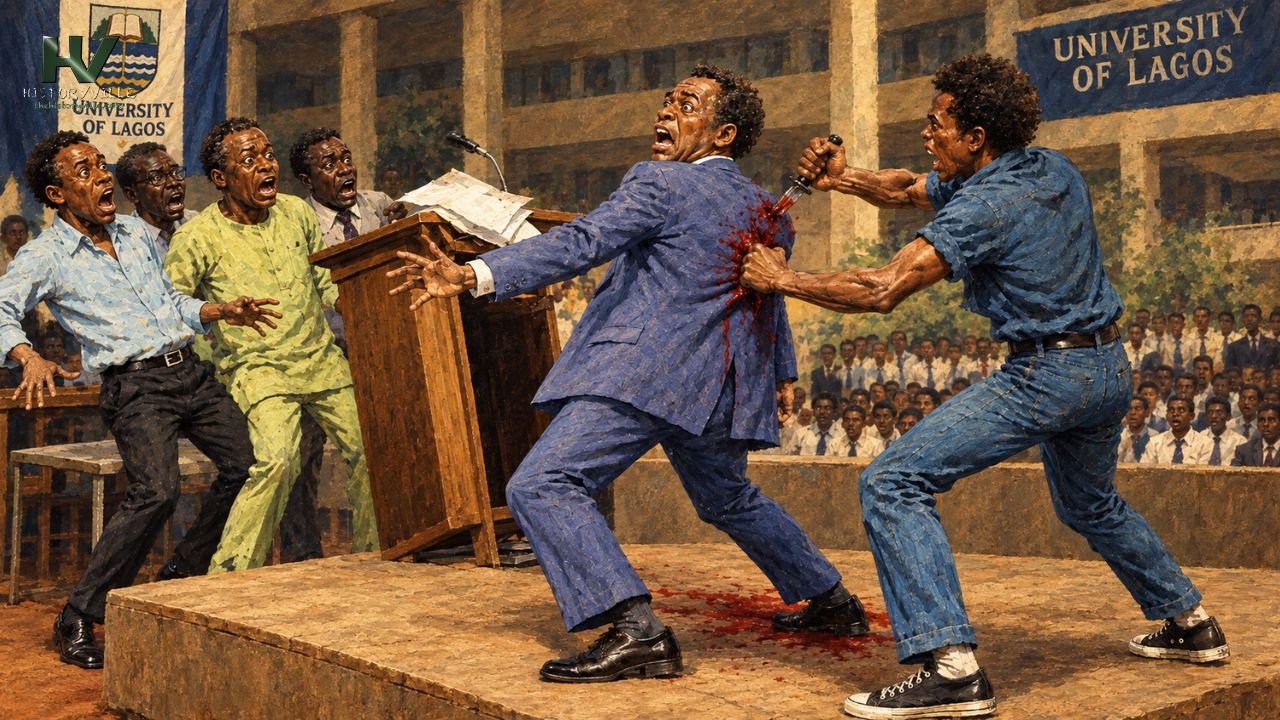
Within days of assuming office, Saburi Biobaku was stabbed in the back by a student with a knife. The attack nearly cost the new Vice-Chancellor his life and became one of the most extraordinary episodes in the early history of the University of Lagos.
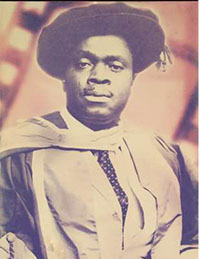
The incident was the result of a bitter dispute over the non-renewal of the appointment of the university’s first Vice-Chancellor, Professor Eni Njoku, and the subsequent choice of Biobaku instead. The dispute had already divided students, academics and members of the university’s governing bodies. By the time Biobaku arrived, the university was a political battleground.
Nigeria’s First Republic and the Politics Behind the Crisis
The crisis at the University of Lagos unfolded against the increasingly unstable politics of Nigeria’s First Republic. At independence in 1960, the federal government was built around a coalition between the Northern People’s Congress (NPC) and the National Council of Nigeria and the Cameroons, later the National Council of Nigerian Citizens (NCNC), while the Action Group (AG) was outside the federal government. The political balance changed considerably after the collapse of the NPC-NCNC relationship and the realignment of parties before the 1964 federal election.
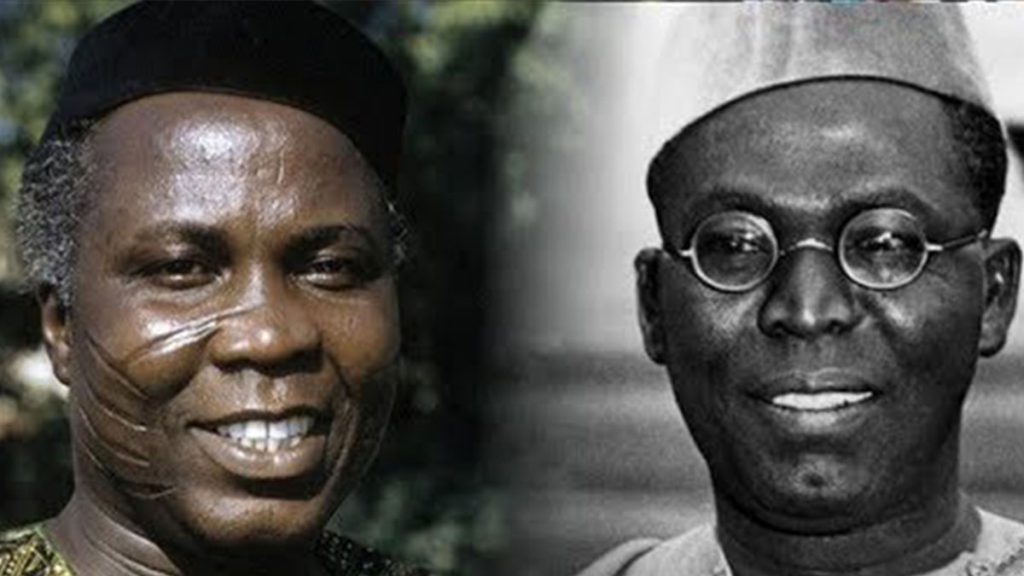
By then, the Nigerian National Alliance (NNA), dominated by the NPC and including Chief Samuel Ladoke Akintola‘s Nigerian National Democratic Party (NNDP), confronted the United Progressive Grand Alliance (UPGA), which brought together the NCNC, the Action Group and other parties. The political conflict was increasingly interpreted through regional and ethnic identities, although the actual alliances were more complicated than a simple North-versus-South division.
Akintola’s break with the Action Group was particularly important. After his conflict with Obafemi Awolowo, Akintola formed the NNDP and subsequently aligned himself with the NPC. The 1964 election produced an NNA-dominated federal government, and the NNDP gained an influential position within the federal administration. Richard Akinjide, an important figure in the NNDP, became Minister of Education in 1965.
This political background mattered because universities were not insulated from the arguments taking place outside their gates. Appointments to senior academic positions could become politically charged, especially when they involved prominent Nigerian academics whose regional or ethnic identities were well known.
The University of Lagos was particularly vulnerable. Founded in 1962, it was only three years old when the crisis erupted. Its first Vice-Chancellor was Professor Eni Njoku, a distinguished botanist and one of Nigeria’s early generation of professors.
The university’s own history records that Njoku served from 1962 until 1965, when the disagreement over whether his appointment should be renewed developed into a major institutional crisis.
How Saburi Biobaku Became UNILAG Vice-Chancellor
Saburi Biobaku was not an obscure academic who suddenly appeared at the University of Lagos. Born on June 16, 1918, in Abeokuta, he had established himself as a historian and university administrator long before 1965. He attended Government College, Ibadan, studied at Exeter and Cambridge, and obtained postgraduate qualifications in history from the University of London. He later became the first African Registrar of University College Ibadan and served in the administration of the Western Region.
His scholarship was equally significant. His The Egba and Their Neighbours, 1842–1872, first published in 1957, became an important work in Nigerian historiography.[1] He would later edit Sources of Yoruba History and publish other works on Nigerian and Yoruba history. Library records also preserve his two autobiographical volumes, When We Were Young[2] and When We Were No Longer Young.[3]
The controversy began with the decision not to renew Eni Njoku’s term as Vice-Chancellor. Njoku had been appointed the first Vice-Chancellor when UNILAG opened in 1962 and served until 1965. His removal became controversial because many members of the university community believed that ethnic considerations had influenced the decision.
Aja Nwachukwu, an Igbo and an NCNC member, served as Federal Minister of Education from 1958 to 1965. He was instrumental in the appointment of Professors Eni Njoku as Vice-Chancellor of the University of Lagos in 1962 and Kenneth Onwuka Dike as Vice-Chancellor of University College, Ibadan in 1963. Both were Igbo men. Although qualified, there were more senior Yoruba professors; among them was Professor Oladele Ajose (1907-1978), the first tenured professor in Nigeria.
This did not go down well with the leading Yoruba politicians of the day, and when Chief Richard Akinjide became Minister of Education in 1965, the University of Lagos Governing Council refused to renew Eni Njoku’s tenure as Vice-Chancellor, and Professor Saburi Biobaku, a renowned historian and an Egba man from Igbore, Abeokuta, present-day Ogun State, was appointed as Vice-Chancellor.
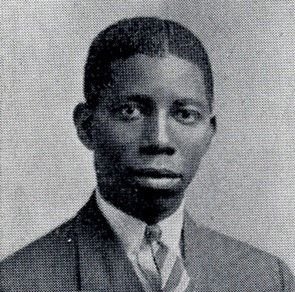
The allegation among critics was that the replacement of an Igbo Vice-Chancellor, Eni Njoku, with a Yoruba historian, Saburi Biobaku, represented ethnic patronage. That was the perception that fuelled the student protests, regardless of whether it fully explains the governing council’s decision.
There was, therefore, an important distinction between Biobaku himself and the controversy surrounding his appointment. Saburi Biobaku was an accomplished scholar with credentials that clearly qualified him for senior academic leadership. But to many students in the tense atmosphere of 1965, his appointment had become a symbol of the political struggle over who controlled the university.
The university’s own institutional history records that the dispute over Njoku’s reappointment divided the governing council, Senate, staff and students.[4] Five deans were eventually dismissed, several supporters of Njoku resigned, and the university was temporarily closed. Biobaku succeeded Njoku at the beginning of what UNILAG’s historians describe as a new phase in the institution’s development.
Students Reject the New Vice-Chancellor
The opposition to Biobaku did not begin with the stabbing. Students had already protested against the decision to replace Njoku. The controversy became sufficiently serious that the university community was divided into opposing camps.
A contemporary report from the Daily Times dated March 4, 1965, described clashes between opposing student factions over Biobaku’s appointment.[5] One student was rendered unconscious, and four others were seriously injured, while the police used tear gas to disperse the fighting. Eni Njoku himself appeared before the students and appealed to them, telling them that the university was greater than any individual and would survive them all.
The incident showed that this was no longer simply an argument inside a governing council about the renewal of a Vice-Chancellor’s tenure. The students had made the appointment a matter of principle and were prepared to confront one another over it. They also believed that the Federal Government had allowed ethnic considerations to influence the appointment. That interpretation also appeared in later accounts of the crisis, although the precise motives of every person involved cannot be established simply from the political identities of the officials concerned.
The government, nevertheless, proceeded. Saburi Biobaku became Vice-Chancellor.
The authorities apparently believed that the protests would not prevent him from taking office. The new Vice-Chancellor was given assurances concerning his security and proceeded to the university to begin his tenure.
He could hardly have known how dangerous his first public encounter with the students would become.
The Stabbing of Saburi Biobaku
On Wednesday, June 9, 1965, 46-year-old Saburi Biobaku addressed students at the University of Lagos. It was an important occasion for a new Vice-Chancellor. He needed to introduce himself to the students, establish a relationship with the university community and begin his administration. Instead, the event ended in violence.
The precise sequence of events is preserved unusually well because the stabbing eventually became the subject of a criminal case that reached the Supreme Court of Nigeria. The court record states that Ted Kayode Adams stabbed Dr Saburi Biobaku with a sharp knife at the University of Lagos, with the prosecution alleging an intent to kill him. Adams would deny the intent to kill.[6]
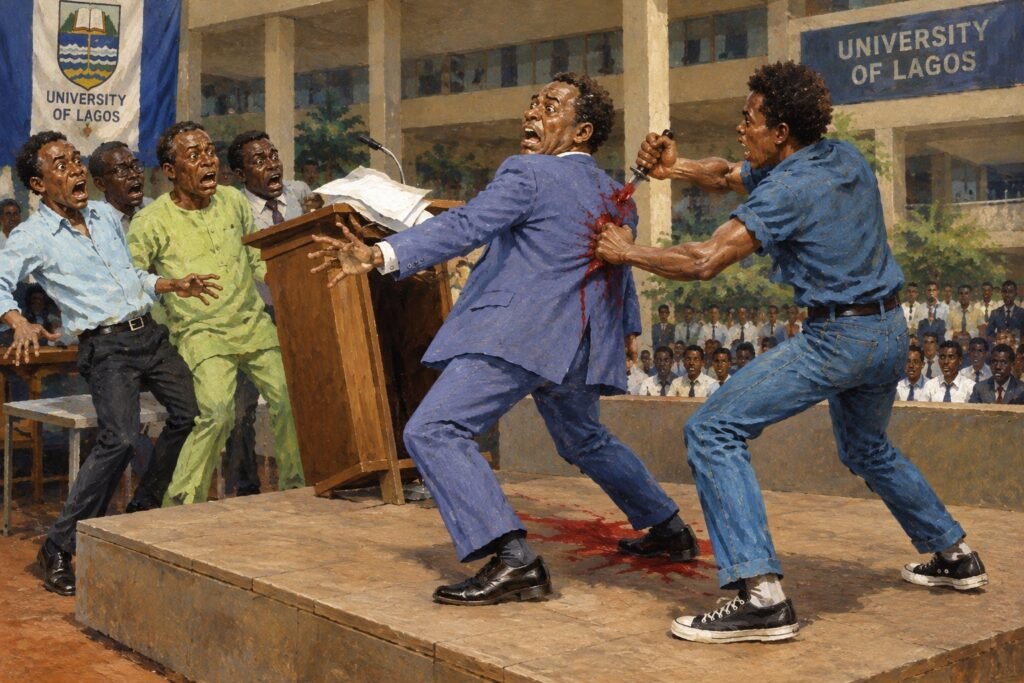
Contemporary newspaper reporting provides further detail. A July 1965 report in the Nigerian Morning Post stated that Adams attacked Biobaku when the Vice-Chancellor was about to enter his car after addressing the students.[7] The same report identified Adams as a 21-year-old second-year law student and said that he was arrested after the attack.
Other accounts describe Adams as a radical student activist who opposed the removal of Eni Njoku. The commonly repeated version is that he moved out from among the students and stabbed Biobaku in the back. The contemporary court record confirms the stabbing and the alleged intent to kill.
For Biobaku, the confrontation must have been sudden. He had entered the university amid a political controversy, but he was addressing the students rather than confronting them physically. Then, in the middle of the crisis surrounding his appointment, a student attacked him with a knife.
Adams was immediately arrested, while the wounded Vice-Chancellor was taken for medical treatment. Thankfully, Biobaku survived. The attack transformed what had already been a serious university dispute into a national scandal. A disagreement over an academic appointment had produced an attempt on the life of the university’s chief executive.
The University of Lagos was subsequently shut down temporarily as the authorities struggled to restore order, but it entered a new phase under Biobaku after the crisis.
What Happened to Kayode Adams?
The fate of Kayode Adams is almost as remarkable as the attack itself.
Adams was prosecuted for attempting to kill Saburi Biobaku. His case eventually reached the Supreme Court as Ted Kayode Adams v. Director of Public Prosecutions of the Federation. The judgment, delivered in January 1966, provides one of the most authoritative surviving records of the attack.[8]
At trial, Adams did not simply deny the stabbing. His defence centred on insanity and the claim that he had acted under an uncontrollable impulse. The eight-member jury found that Adams had committed the act but that, at the time, he was suffering from an uncontrollable impulse. The trial judge consequently ordered that he be detained at the Yaba Mental Asylum and that a report be sent to the President under the Criminal Procedure Act.
This detail is important because later accounts sometimes describe Adams simply as having been convicted and sent to a psychiatric institution. The legal record is more precise. The jury accepted that he had carried out the act but found that the circumstances surrounding his mental state affected his criminal responsibility. His case therefore became significant in Nigerian criminal law, particularly in relation to the defence of insanity.
The Supreme Court considered the legal questions raised by the verdict and the order of detention. Its judgment is valuable because it confirms the basic facts of the attack independently of later newspaper retellings.
Adams did not remain at the university. He was detained at Yaba, and his subsequent life ended in October 1969. Newspaper references from the period report that his body was found at the Lagos waterfront. Later accounts commonly describe his death as drowning at Bar Beach.
It is worth being careful with the often-repeated claim that Adams committed suicide at Tarkwa Bay. The available references do not establish that with the same certainty as the stabbing itself. The surviving accounts cited in later biographies refer to his body being found at Bar Beach and include a later newspaper article explicitly questioning the circumstances of his death. It is, therefore, safer to say that Adams was found dead at the beach in October 1969 rather than present suicide as an established fact.
Saburi Biobaku Survived and Led UNILAG Through a New Era
The stabbing did not end Saburi Biobaku’s career at the University of Lagos.
After recovering from his injuries, he continued as Vice-Chancellor. UNILAG’s official history records his tenure as 1965–1971[9] and credits his administration with several important developments, including the university’s first convocation in January 1968, the conferral of its first doctoral degrees, the integration of the medical school into the university and the promulgation of the University of Lagos Decree.[10]
This is an important part of the story because the stabbing could easily overshadow everything Biobaku subsequently achieved. He had arrived at UNILAG under extraordinary circumstances, survived an attack by a student, and then remained in office for six years.
His tenure also coincided with one of the most turbulent periods in Nigerian history. The First Republic collapsed in January 1966, only months after his appointment and the stabbing. The country subsequently experienced military rule, civil war and profound political change. Yet, the University of Lagos continued to develop.
Saburi Biobaku remained an important figure in Nigerian intellectual life after leaving the Vice-Chancellorship. His later publications included The Origin of the Yoruba, Sources of Yoruba History and The Living Culture of Nigeria. His autobiographical writings also provide valuable material for understanding the world in which he grew up and worked.
Interestingly, the story of Saburi Biobaku extends far beyond the knife attack of 1965. He was a historian whose career stretched across colonial rule, independence and the turbulent years of the First Republic. His appointment to UNILAG placed him at the centre of one of the earliest major confrontations between Nigerian university politics and national politics. He went on to lead the University of Lagos until 1971, while the institution itself emerged from the crisis and entered what its own historians call its “Period of Renewal”.
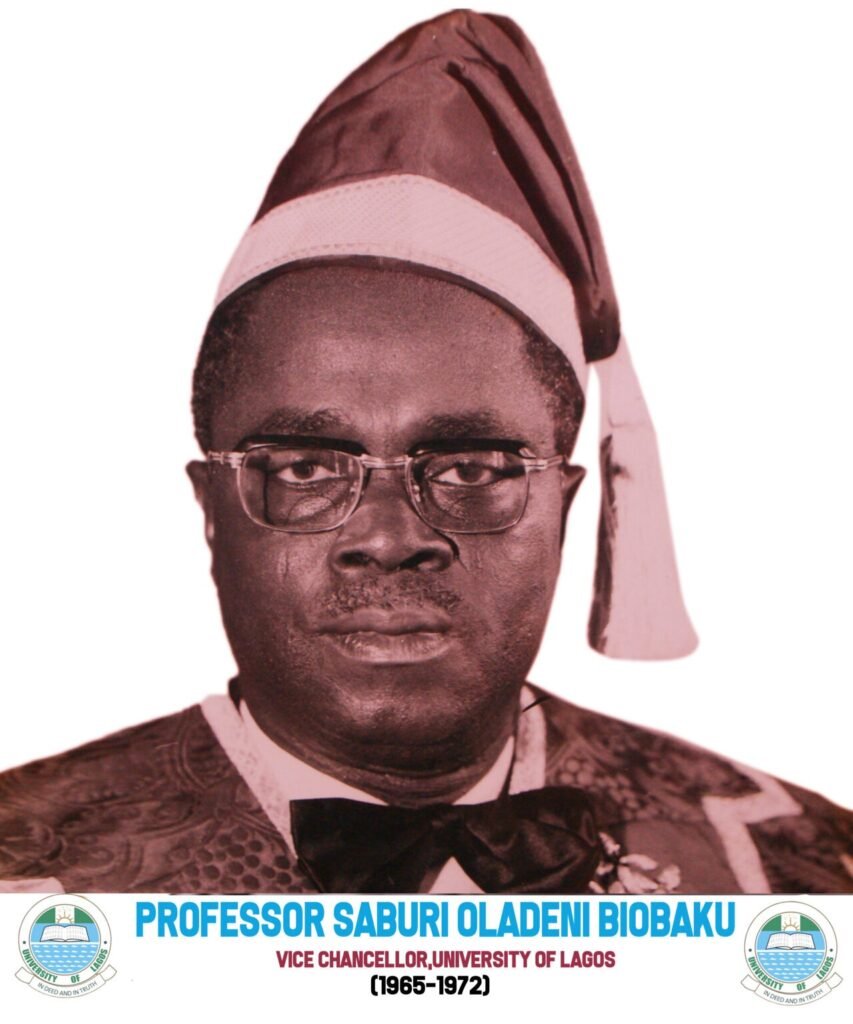
More than half a century later, the episode remains one of the strangest chapters in the history of Nigerian higher education: a distinguished historian arrived to lead a young university at a time of intense political division, and before his administration had properly begun, a student tried to kill him.
Saburi Biobaku survived the attack. The University of Lagos survived the crisis. But the stabbing revealed how closely the politics of Nigeria’s First Republic could reach into the lecture halls and corridors of its universities.
However, Professor Saburi Biobaku would live for another 35 years and eight months after the knife attack on him by Kayode Adams and died on Thursday, February 8, 2001, in England, United Kingdom, after a brief illness. He was 82.[11]
Want to understand what really happened during Nigeria’s first military coup? Read A Carnage Before Dawn. It offers a carefully researched, vividly told account of January 15, 1966, through a storytelling style that will keep you glued to the book’s pages.
You can get the e-book here and the paperback here.
Love history? Don’t stop here.
📚 Get deeper insights by purchasing our latest history books.
📢 Join our WhatsApp Channel for exclusive updates and historical facts.
📩 Subscribe to our Newsletter and receive fascinating stories from history (World and African history) directly in your inbox.
🎥 Subscribe to our YouTube channel for engaging documentaries and short history videos.
Stay connected with us on social media for daily history content:
🔵Follow us on Facebook.
📸 Follow us on Instagram.
🐦Follow us on Twitter.
💼 Follow us on LinkedIn.
🎵 Follow us on TikTok.
❤️ Support our work by donating to HistoryVille and help us continue preserving and sharing important historical stories. 📢Advertise with HistoryVille to reach a growing audience passionate about history and culture.
References
- [1] Biobaku, Saburi O. The Egba and Their Neighbours, 1842–1872. Oxford: Clarendon Press, 1957.
- [2] Biobaku, Saburi O. When We Were Young. Ibadan: Spectrum Books, 1992.
- [3] Biobaku, Saburi O. When We Were No Longer Young. Ibadan: Spectrum Books, 1999.
- [4] Akinyele, R. T., and Olufunke Adeboye. “The Journey So Far.” In The University of Lagos: Fifty Years of Excellence, 1962–2012. University of Lagos, 2012.
- [5] Daily Times. “University of Lagos Students Clash over Vice-Chancellor.” March 4, 1965.
- [6] Spear. January 1970, 7.
- [7] Nigerian Morning Post. Report on the attack on Professor Saburi Biobaku and the prosecution of Ted Kayode Adams. July 10, 1965.
- [8] Adams, Ted Kayode v. Director of Public Prosecutions of the Federation. Supreme Court of Nigeria, January 14, 1966. (1966) LCN/1353(SC).
- [9] University of Lagos. “History of Vice Chancellors.” University of Lagos. Accessed September 30, 2026.
- [10] University of Lagos. Installation of the Chancellor. University of Lagos Order of Proceedings, 1968. University of Lagos Institutional Repository.
- [11] Babalola, Lanre. “Professor Biobaku Is Dead.” PM News, February 9, 2001, 1, 6.