
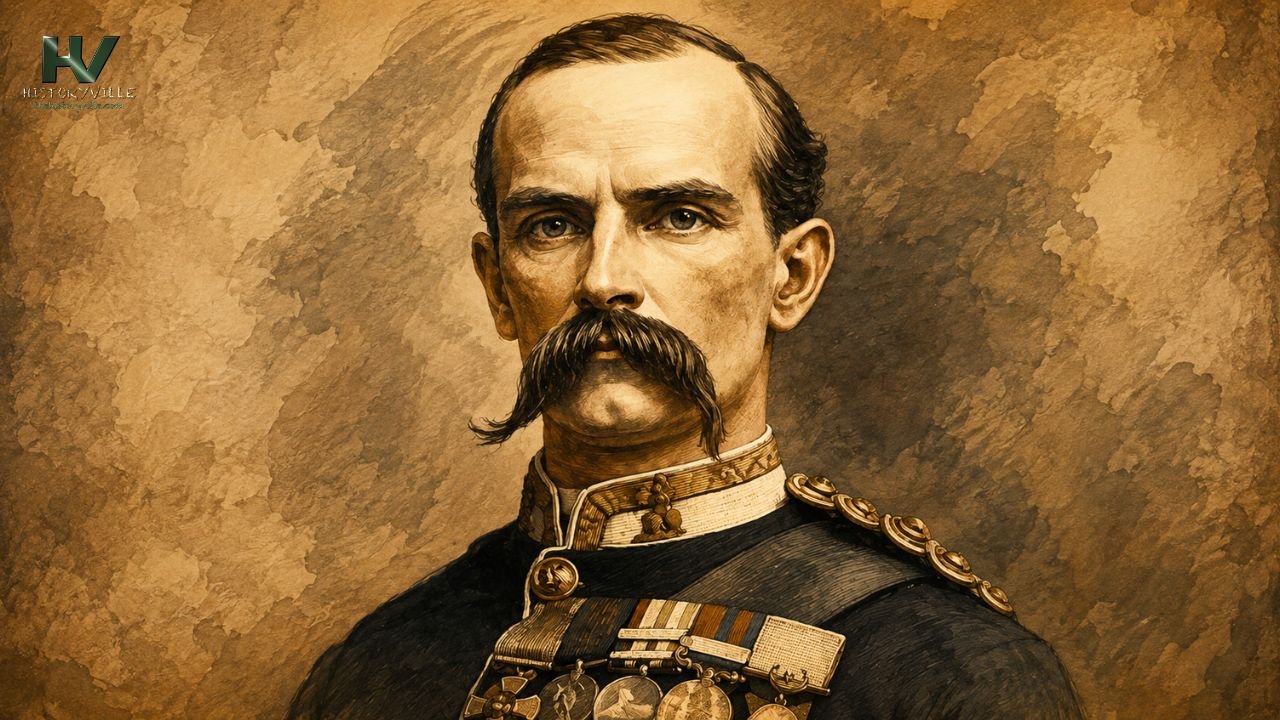

On January 1, 1914, Lord Frederick Lugard oversaw the amalgamation of the Northern and Southern Provinces of Nigeria to form what is now the Federal Republic of Nigeria.
Frederick Lugard, who assumed the office of the Protectorate of Northern Nigeria High Commissioner in 1900, has often been considered the model British colonial administrator.

So, why did Lugard join two different “countries” as one in the same year the First World War began?
Frederick Lugard
Trained as an army officer, Frederick Lugard had served in India, Egypt, and East Africa, expelling Arab slave traders from Nyasaland, and establishing the British presence in Uganda.
In 1894, Lugard joined the Royal Niger Company and was sent to Borgu to counter French inroads, and in 1897 he was made responsible for raising the Royal West African Frontier Force from local duties to serve under British officers.
Throughout his term as the High Commissioner of Northern Nigeria, Lugard was busy turning the economic sphere of influence inherited from the Royal Niger Company into a viable territorial body under strong British political control.
His aim was to conquer the region as a whole and obtain recognition by its indigenous rulers, particularly the Sokoto Caliphate Fulani emirs, for the British protectorate.
Lugard’s campaign actively suppressed local resistance and used armed force after the failure of diplomatic initiatives.
In 1903, Kanem-Bornu surrendered to Lugard’s Armed Forces without a fight. However, Lugard mounted attacks on Kano and Sokoto.
From the point of view of Lugard, clear-cut military victories were important; otherwise, their surrenders weakened the resistance.
Indirect Rule in Northern Nigeria
Lugard’s popularity in Northern Nigeria was due to his policy of indirect rule, which required that the rulers who had been defeated administer the protectorate.
If the Emirs embraced British authority, abolished the slave trade and cooperated with British officials to modernise their government, the colonial power was willing to confirm them in office.
The emirs kept their titles of caliphate but were accountable to British district officials, who had final authority. Emirs and other officials could be deposed by the British High Commissioner if necessary. Lugard sharply reduced the number of titled fief holders in the emirates, which undermined the influence of the rulers.
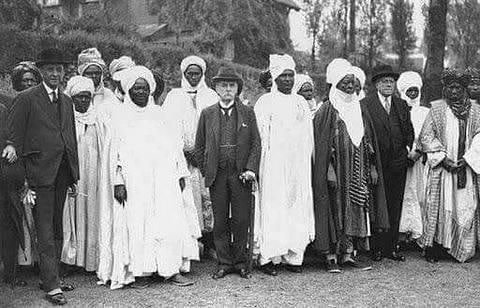
Caliphate officials were converted under indirect rule into salaried district heads and became, in essence, agents of the British authorities, responsible for peacekeeping and tax collection. The old chain of command was merely capped with a new overlord, the high commissioner of Britain.
The protectorate required only a limited number of colonial officers who were dispersed as overseers throughout the territory.
They exercised discretion in advising the emirs and local officials, depending on local circumstances, but all instructions from the high commissioner were transmitted through the emir.
Though the high commissioner in the protectorate possessed unlimited executive and legislative powers, most of the government’s activities were undertaken by the emirs and their local administrations, subject to British approval.
A dual system of law worked: the sharia court (Islamic law) tended to deal with matters concerning Muslims’ personal status, including land disputes, divorce, debt, and slave emancipation.
As a result of indirect rule, the domination of Hausa-Fulani was confirmed – and in some cases forced on diverse ethnic groups, some of them non-Muslim, in the so-called Middle Belt of Nigeria.
The accomplishments of Lugard and his successors in economic development were limited by the revenues available to the colonial government. One of Lugard’s initial acts was to separate the general treasury of each emirate from the emir’s privy purse.
From taxes collected by local officials, first one-quarter and later one-half was taken to support services of the colonial regime, which were meagre because of the protectorate’s lack of public resources.
Indirect Rule in Southern Nigeria
In the south, missionaries made up for the lack of government expenditure on services; in the north, Lugard and his successors limited the activities of missionaries in order to maintain Muslim domination.
Consequently, educational and medical services in the north lagged behind those in the south. Progress was made in economic development, however, as railroad lines were constructed to transport tin from Jos Plateau and northern-grown peanuts and cotton to ports on the coast, which were subsequently sent to England.
Efforts to apply indirect rule to the south, which formally became a protectorate in 1906, in emulation of Lugard’s successful policy in the north set off a search for legitimate indigenous authorities through whom the policy could be implemented.
The task proved relatively easy in Yorubaland, where the governments and boundaries of traditional kingdoms were retained or, in some instances, revived.
Among the Igbos of the southeast, where Aro hegemony had been crushed, the search for acceptable local administrators was met with frustration.
As a result, the tasks of government initially were left in the hands of colonial officials, who antagonised many Igbo. The Igbo therefore stressed traditional egalitarian principles as a justification for their early opposition to colonial rule; in Yorubaland and in the north, the devolution of administrative duties to the indigenous ruling elites contained much of the early opposition. Resistance to colonial rule was mitigated to the extent that local authorities and courts were able to manage affairs.
The British prohibited the enslavement of free persons and suppressed slave trading. All children in the north who were born to persons in bondage on or after April 1, 1900, were declared free.
The relations between existing slaves and their owners, however, were allowed to continue indefinitely, on the assumption that wholesale liberation would cause more harm than good by disrupting the agricultural economy. As a consequence, at least several hundred thousand slaves deserted their masters in the early years of colonial rule.
In 1906, a radical religious uprising that received the support of many fugitive slaves was brutally crushed. In the South, slaves legally could be forced to return to their owners until 1914. In the North, vagrancy laws and the enforcement of proprietary rights to land were used to check the flight of slaves.
Slaves in the northern emirates could secure their freedom upon application to an Islamic court, but comparatively few used this option.
Throughout the colonial period in the Muslim north, many slaves and their descendants continued to work for their masters or former masters and often received periodic payments leading to emancipation.
The Amalgamation of Nigeria
In 1912, Frederick Lugard was appointed Governor-General of Southern and Northern Nigeria with the mandate to unite the two Protectorates. His main mission was to complete the amalgamation into one colony.
Northern Nigeria, at 716,880 km², occupy 77.6% of Nigeria’s landmass, which is nearly four times the size of Southern Nigeria at 206,888 km².
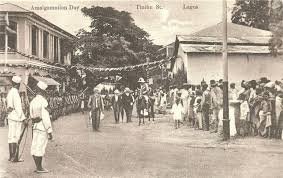
Although controversial in Lagos, where it was opposed by a large section of the political class and the media, the amalgamation did not arouse passion in the rest of the country.
From 1914 to 1919, Lugard was made Governor-General of the now-combined British Colony of Nigeria.
The amalgamation was done for economic reasons rather than political. Northern Nigeria Protectorate had a budget deficit, and the colonial administration sought to use the budget surpluses in Southern Nigeria to offset this deficit.
The disparities between the Protectorates were to be corrected by creating a central administration in Lagos, with customs revenues from the South paying for the projects in the North.
Lugard ran the country with half of each year spent in England, distant from realities in Africa, where subordinates had to delay decisions on many matters until he returned, and based his rule on a military system.
Want to understand what really happened during Nigeria’s first military coup? Read A Carnage Before Dawn. It offers a carefully researched, vividly told account of January 15, 1966, through a storytelling style that will keep you glued to the book’s pages.
You can get the e-book here and the paperback here.
Love history? Don’t stop here.
📚 Get deeper insights by purchasing our latest history books.
📢 Join our WhatsApp Channel for exclusive updates and historical facts.
📩 Subscribe to our Newsletter and receive fascinating stories from history (World and African history) directly in your inbox.
🎥 Subscribe to our YouTube channel for engaging documentaries and short history videos.
Stay connected with us on social media for daily history content:
🔵Follow us on Facebook.
📸 Follow us on Instagram.
🐦Follow us on Twitter.
💼 Follow us on LinkedIn.
🎵 Follow us on TikTok.
❤️ Support our work by donating to HistoryVille and help us continue preserving and sharing important historical stories. 📢Advertise with HistoryVille to reach a growing audience passionate about history and culture.