
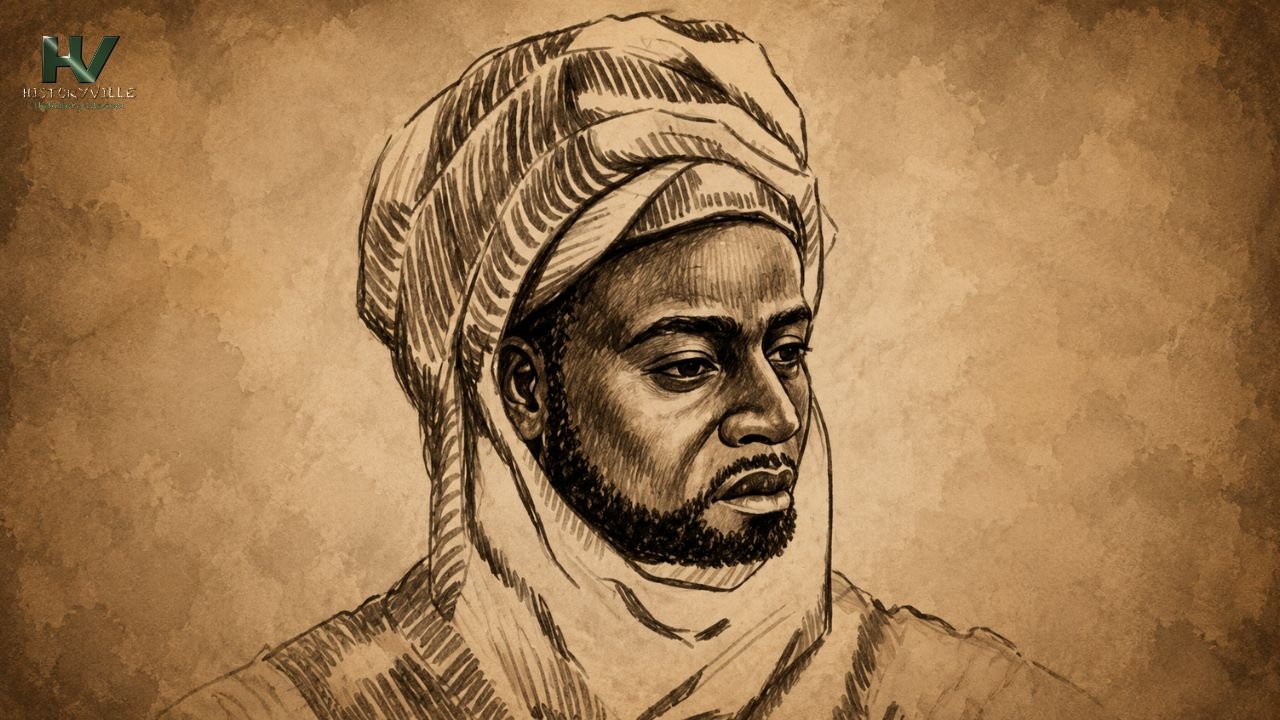

In 1809, Usman dan Fodio (December 15, 1754 – April 20, 1817) founded the Sokoto Caliphate. Dan Fodio, a religious author, writer and Islamic activist, was one of the urbanised ethnic Fulani communities living in the Hausa States in what is now northern Nigeria.
An instructor at the Maliki School of Law and the Qadiriyyah Order of Sufism, he remained in the city-state of Gobir until 1802, when, inspired by his reformist ideas and growing persecution by local authorities, he led his followers into exile.
This exile started a political and social transition that spread from Gobir to modern Nigeria and Cameroon and echoed in the ethnically Fula-led Jihad movement throughout West Africa.
Usman dan Fodio: A Scholar
Usman dan Fodio refused much of the pomp of rule, and although establishing connections with religious reformers and Jihad leaders across Africa, he soon handed the real leadership of the Sokoto state over to his son, Muhammed Bello.
Dan Fodio wrote more than a hundred books on religion, administration, culture, and community. He blamed the African Muslim rulers for what he saw as corruption, paganism, or breach of the principles of Sharia law, and heavy taxation.
He promoted literacy and education, particularly for women, and many of his daughters became scholars and authors. His works and sayings are still very much quoted today.
The Teachings of Usman dan Fodio
Usman dan Fodio’s rebellion is a major episode of a movement identified as the Fulani hegemonies of the 17th, 18th and 19th centuries. It was followed by active jihads in Fuuta-Jalon and Fuuta-Tooro between 1650 and 1750, which led to the formation of these three Islamic states.
Dan Fodio, in addition, influenced a host of later West African jihads, including the founder of the Masina Empire, Seku Amadu, the founder of the Toucouleur Empire, El Hadj Umar Tall, who would marry one of Usman Dan Fodio’s granddaughters, and the founder of the Adamawa Emirate, Adama Modibo.
Dan Fodio was well educated in classical Islamic science, philosophy, and theology, and became a respected theological thinker. His teacher, Jibril ibn Umar, argued that it was the responsibility and power of the religious movements to create an ideal society free from injustice and vice. His teacher was a North African Muslim who gave his pupil a wider perspective on Muslim reformist ideas in other parts of the Muslim world.
Usman dan Fodio’s 1804 Sokoto Jihad
In 1802, the ruler of Gobir and one of Dan Fodio’s pupils, Yunfa, turned against him, revoking Degel’s autonomy and seeking to assassinate Dan Fodio.
Dan Fodio and his supporters fled to the western grasslands of Gudu (now Sokoto State), where they turned to back the local Fulani nomads. Usman dan Fodio was then proclaimed the Commander of the Faithful in Gudu. This made him a political leader as well as a religious leader, giving him the power to announce and undertake a jihad, raise an army, and become its commander-in-chief.

Image Credit: Wikipedia
In Hausaland, a widespread rebellion started. This revolt was largely composed of the Fulani, who had a strong military advantage due to their cavalry. This was also strongly endorsed by the peasantry of Hausa, who felt over-taxed and marginalised by their rulers. Usman dan Fodio then launched the jihad against Gobir in 1804.
The Birth of the Fulani Empire
During the jihad, Fulani contact was carried along commercial routes and rivers flowing to the Niger-Benue valley, as well as the delta and the lagoons. Not only did the appeal for jihad touch other states like Kano, Katsina, and Zaria, but also Bornu, Gombe, Adamawa, Nupe, and Ilorin. Those were all locations with large or small groups of Fulani scholars.
Within just a few short years of the 1804 jihad, Usman dan Fodio was at the helm of the largest state in Africa, the Fulani Empire. His son, Muhammad Bello and his brother, Abdullahi, carried out the jihad and took control of the administration of the Empire. Dan Fodio worked to create an effective government based on Islamic law.

Death and Legacy
Usman Dan Fodio retired after 1811 and continued to write about the moral actions of the Muslim faith. Upon Dan Fodio’s death in 1817, Muhammed Bello, his son, succeeded him as Sultan and became the ruler of the Sokoto Caliphate, which at the time was the largest state south of the Sahara.
Usman’s brother, Abdullahi, was appointed the Emir of Gwandu and was put in charge of the Western Emirates, Nupe, and Ilorin. Thus, all the Hausa provinces, parts of the Nupe, Ilorin and Fulani outposts in Bauchi and Adamawa were all ruled by a single political-religious structure.
There were 12 caliphs from the time of Usman Dan Fodio until the British conquest of Sokoto, at the beginning of the 20th century, by Lord Frederick Lugard in 1903.
Want to understand what really happened during Nigeria’s first military coup? Read A Carnage Before Dawn. It offers a carefully researched, vividly told account of January 15, 1966, through a storytelling style that will keep you glued to the book’s pages.
You can get the e-book here and the paperback here.
Love history? Don’t stop here.
📚 Get deeper insights by purchasing our latest history books.
📢 Join our WhatsApp Channel for exclusive updates and historical facts.
📩 Subscribe to our Newsletter and receive fascinating stories from history (World and African history) directly in your inbox.
🎥 Subscribe to our YouTube channel for engaging documentaries and short history videos.
Stay connected with us on social media for daily history content:
🔵Follow us on Facebook.
📸 Follow us on Instagram.
🐦Follow us on Twitter.
💼 Follow us on LinkedIn.
🎵 Follow us on TikTok.
❤️ Support our work by donating to HistoryVille and help us continue preserving and sharing important historical stories. 📢Advertise with HistoryVille to reach a growing audience passionate about history and culture.