
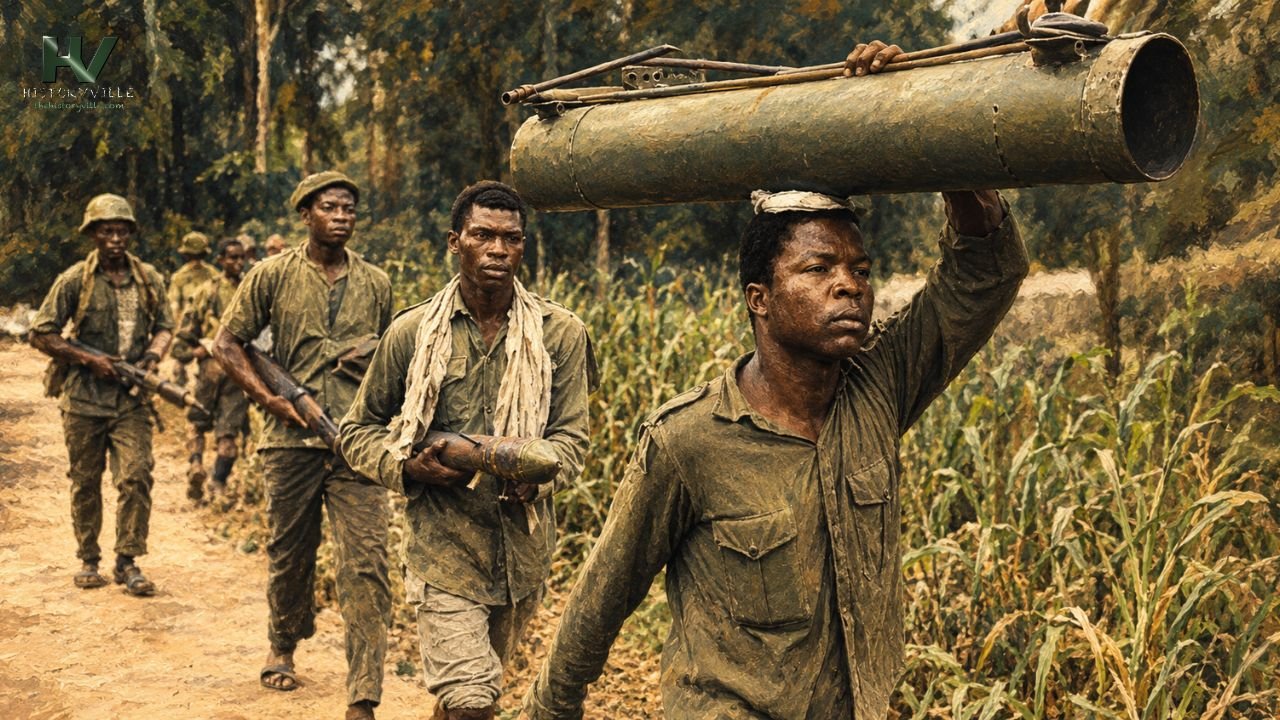

Ogbunigwe, the deadly mass-destruction missile that made the Nigerian federal troops jittery, was a product of the scientific feat of the breakaway nation of Biafra. It was, allegedly, the first technology to be wholly designed, developed, mass-produced, and launched in Africa.[1]
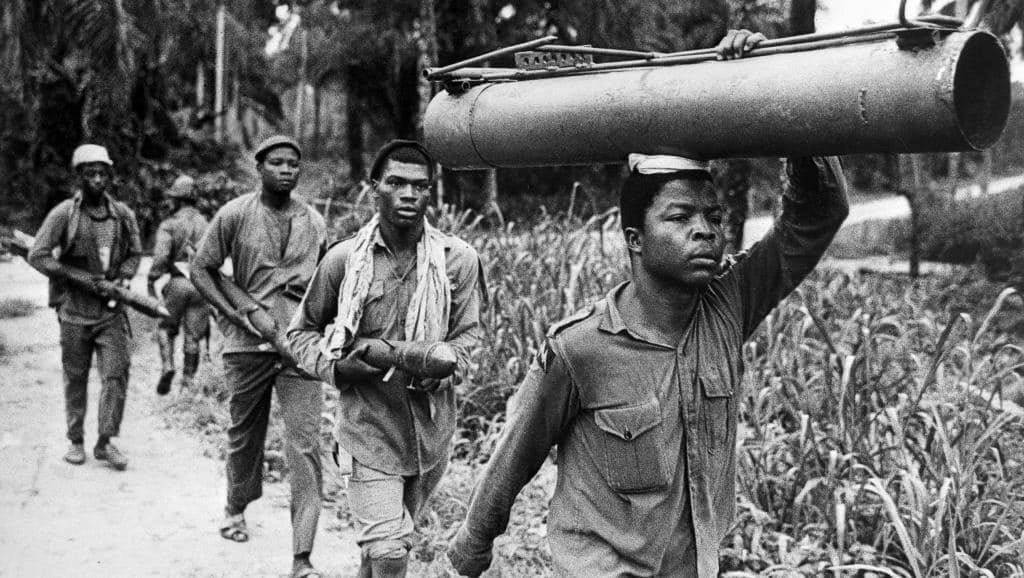
It was used in combat during the Nigeria-Biafra War (1967-1970), and at the height of production, about 500 units were reported to be manufactured per day in Biafra.
How the Ogbunigwe was invented
Ogbunigwe, also known as Ojukwu’s Bucket (named after the Biafran Head of State Chukwuemeka Odumegwu Ojukwu), was based on the physics of the “Munroe or Neumann effect”. It killed and maimed by wave-effect percussion and dispersal of shrapnel. It was shaped either as a cone or cylinder and could be used as a land mine, a ground-to-ground projectile against troop concentrations, or a ground-to-air anti-personnel “air burst” cluster bomb.
With the economic blockade of Biafra having a telling effect, the people turned inwards, devising survival strategies and apparatuses. Apart from extracting and refining their own petrol, they also had improvised armoured tanks and piloted their planes. The renowned Professor Gordian Ezekwe led a team of scientists in what was known as the Biafran Research and Production Unit. This think-tank group was tasked with developing rockets, bombs, and telecommunications gadgets.[2]
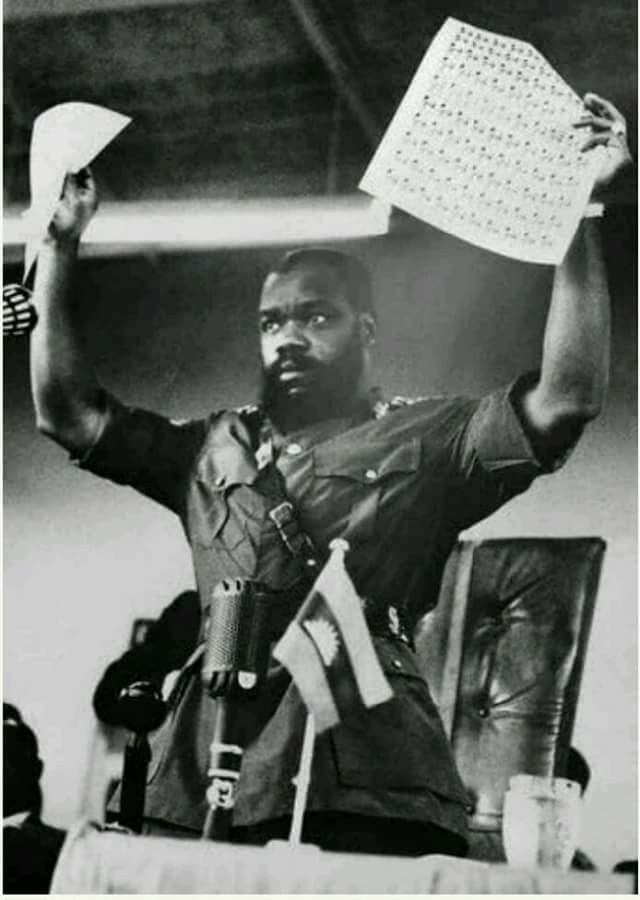
How Biafra used the Ogbunigwe
The Ogbunigwe mines and warheads generally had a killing range of between 180 meters and 800 meters, an effective shrapnel radius of a 90° arc, and could easily wipe out a company of enemy troops. The self-propelled rocket versions had a missile range of eight kilometres. The weapons were annihilating for enemy infantry and armoured vehicles.[3]
In October 1967, the Nigerian federal troops, having captured and secured Enugu, the capital of Biafra, were on their way to Awka and Onitsha, the commercial nerve centre of Biafra, through the old Enugu-Awka-Onitsha Road. The well-armed, heavily equipped federal troops, with their superior firepower, encountered a battalion of poorly equipped, outgunned, and virtually exhausted Biafran troops at the Ugwuoba Bridge, a few kilometres into Awka.
However, the Biafran troops had on hand some of their air defence dust mines. Unable to withstand the superior firepower of the federal troops, they began to run for their lives, carrying their air defence ‘mines’. Their bold and stalwart commander ordered them back and commanded them to fire the mines at the approaching federal troops.
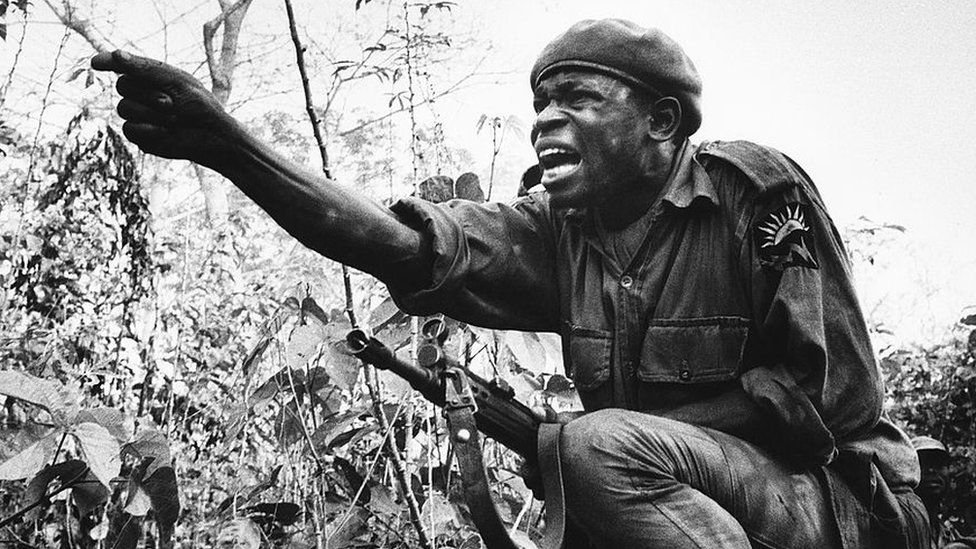
The command was promptly carried out. Indeed, the federal troops could not understand what hit them. The effect of the detonation was devastating, leading to the loss of many federal troops, as well as the loss of large quantities of arms and ammunition, some of which were completely burnt.
The Nigerian troops were so mortally afraid of the Ogbunigwe that each advancing battalion was preceded by a herd of cattle. Many cows lost their lives.
The 1968 Abagana Ambush
Known as the Abagana Ambush, the Second Division of the Nigerian Army, led by Colonel Murtala Muhammed, had finally crossed the Niger Bridge after failing in the first attempt. Muhammed’s forces had been repelled by Colonel Joe ‘Hannibal’ Achuzia’s guerrilla army and had also suffered heavy casualties. Having crossed into Biafra, the plan was to link up with the First Division led by Colonel Mohammed Shuwa, penetrating the Igbo heartland through the north from Nsukka.

March 25, 1968, probably remains one of the most memorable events of the war. It was the day the Nigerian side suffered the heaviest single loss in the war.
With a 700-man team, led by Major Jonathan Uchendu, a counter-attack plan was hatched that essentially sealed up the Abagana Road while the troops lay in ambush in a nearby bush, waiting patiently for the advancing Nigerians and their reinforcements.
Major Uchendu’s strategy proved highly successful as his troops destroyed Muhammed’s entire convoy within one and a half hours with about 500 casualties on the Nigerian side. There was a minimal loss on the Biafran side. It was probably the most resounding battle ever won by the Biafrans in the entire war.
Ogbunigwe: An Effective Biafran Weapon
The Ogbunigwe was the most effective Biafran weapon during the war, and the Nigerian forces were not able to find an efficient defence against it. Well-placed mines or rocket salvos coordinated by a few determined soldiers were often enough to stop an entire Nigerian advance.
The Ogbunigwe, in its various forms, was able to influence the outcome of many battles. It was indeed a weapon of mass destruction.
Want to understand what really happened during Nigeria’s first military coup? Read A Carnage Before Dawn. It offers a carefully researched, vividly told account of January 15, 1966, through a storytelling style that will keep you glued to the book’s pages.
You can get the e-book here and the paperback here.
Love history? Don’t stop here.
📚 Get deeper insights by purchasing our latest history books.
📢 Join our WhatsApp Channel for exclusive updates and historical facts.
📩 Subscribe to our Newsletter and receive fascinating stories from history (World and African history) directly in your inbox.
🎥 Subscribe to our YouTube channel for engaging documentaries and short history videos.
Stay connected with us on social media for daily history content:
🔵Follow us on Facebook.
📸 Follow us on Instagram.
🐦Follow us on Twitter.
💼 Follow us on LinkedIn.
🎵 Follow us on TikTok.
❤️ Support our work by donating to HistoryVille and help us continue preserving and sharing important historical stories. 📢Advertise with HistoryVille to reach a growing audience passionate about history and culture.
References
- [1] Lionel, E. “The Story of a Biafran-Made Weapon, Ogbunigwe Rocket and Abagana Ambush.” African Military Blog, December 6, 2017. https://www.africanmilitaryblog.com/2017/12/the-story-of-a-biafran-made-weapon-ogbunigwe-rocket-and-abagana-ambush.
- [2] Osuji, S. “‘There Was a Country’: Ogbunigwe, Abagana Ambush; Achebe, Okigbo and Ifeajuna.” The Nation, October 23, 2012. https://thenationonlineng.net/there-was-a-country-ogbunigwe-abagana-ambush-achebe-okigbo-and-ifeajuna/.
- [3] Lionel, 2017.