
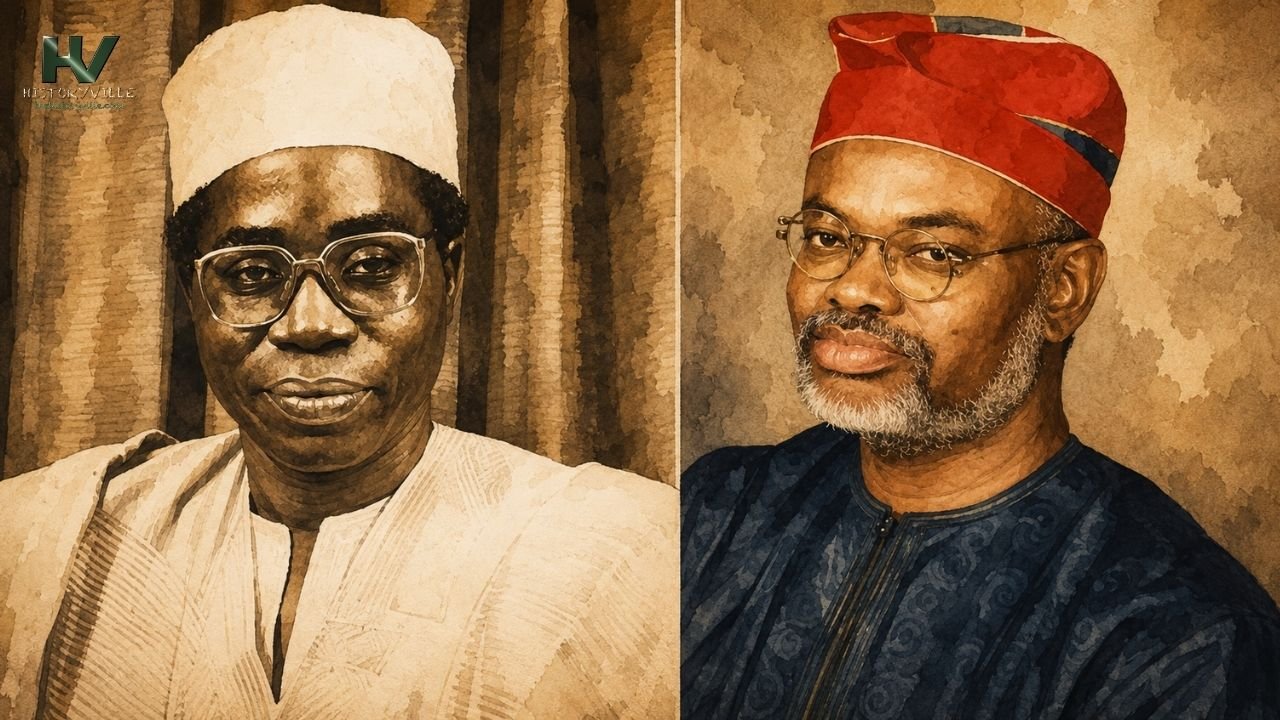

Two of Nigeria’s leading politicians, Bola Ige and Funsho Williams, were assassinated during Nigeria’s nascent Fourth Republic in 2001 and 2006, respectively. While Ige was shot and killed in Ibadan, Williams was stabbed and strangled to death in his home in Lagos.
As a matter of fact, more than fifty politicians or pseudo-politicians have been killed since the return of democracy to Nigeria, and the riddles surrounding their deaths remain unsolved to this day.
Political assassination is the intentional killing of someone, especially a public figure, usually for political reasons.[1] Often, it is perpetuated by a person who occupies or wants to occupy a political position, or by someone who just wants to be in the public eye.
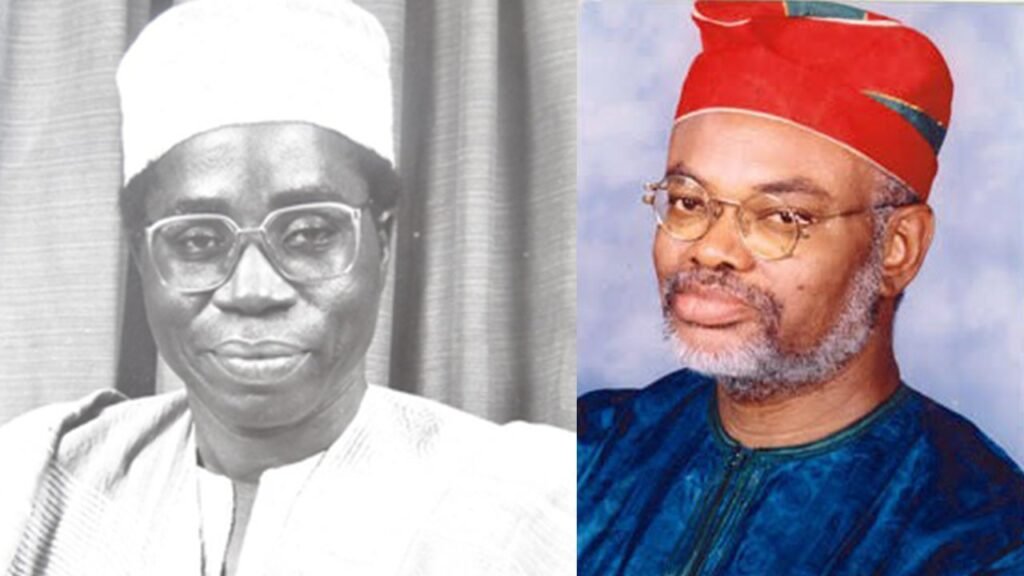
Our focus here is, however, on the deaths of two popular Nigerian politicians: Chief Bola Ige and Engineer Funsho Williams. We’ll examine them one after the other.
Chief Bola Ige: Who was he?
Born on September 13, 1930, Chief James Ajibola Idowu Adegoke Ige hailed from Esa-Oke in Osun State. He had his primary school education in Kaduna, and in 1943, at the age of 14, he left Kaduna for Ibadan, where he got his secondary school education at the famous Ibadan Grammar School.

For his university education, he studied Classics, Latin, and Greek at the University of Ibadan. To further his education, he proceeded to the University College, London, where he obtained a Law degree in 1959 and was called to the Bar in London’s Inner Temple in 1961.
Upon his arrival back to Nigeria in 1961, he set up his own Law firm, Bola Ige & Co., and would years later be appointed a Senior Advocate of Nigeria (SAN).
Chief Bola Ige married a woman named Atinuke Oloko, who was allegedly his high school sweetheart. Their marriage was blessed with children and grandchildren.
What were Chief Bola Ige’s notable contributions to the Development of Nigeria?
As stated previously, Ige was a successful lawyer and family man. He spoke the three major Nigerian languages (Hausa, Igbo, and Yoruba) fluently, which evidenced his strong cultural tolerance.
In the 1970s, Bola Ige committed his time to the anti-racism campaign of the World Council of Churches, an international Non-Governmental Organisation (NGO) concerned with the equality of all races, human beings, and, more recently, the equality of men and women.
During his tenure as the Governor of Oyo State (1979-1983), he introduced and implemented free education at all levels.
Chief Bola Ige was also a founding member of the popular Yoruba pressure group, Afenifere, a socio-cultural organisation for the Yoruba people. Some Yoruba see the organisation as an unnecessary and dangerous group, while a majority view the pressure group as a commendable force that is serving their interests as well as maintaining the influence of Yorubaland in the Federation. Simply put, they consider it to be a vital body towards the preservation of the Yoruba race.

Furthermore, as Minister of Justice/Attorney General of Nigeria (2000-2001), Bola Ige:
- Initiated a program to restructure and consolidate the laws of the Federation, publish them in digital form, and make them available on the website of his ministry.
- Fought against the imposition of Sharia law in the northern states of Nigeria.
- Refrained the Sokoto State government, in November 2001, from executing the judgment of a verdict passed by a Gwadabawa Sharia court to stone a woman, Safiya Hussaini, to death for committing adultery.
Political Career
At the age of 31, Bola Ige became the National Public Secretary of the Action Group (AG) during Nigeria’s First Republic (1963-1966).
Under the military government of General Yakubu Gowon (1967-1970), he was a Commissioner for Agriculture in the now-defunct Western Region of Nigeria.
In the Second Republic, Bola Ige formed an alliance with the Unity Party of Nigeria (UPN) towards the end of the 1970s, through which he was elected governor of Oyo State from October 1979 to October 1983. He ran for re-election in 1983 but lost to Dr Victor Omololu Olunloyo. Ige challenged the validity of the election in court, but it proved futile. Victor Olunloyo, however, lost his position just three months after another military coup that ushered in Major-General Muhammadu Buhari.
Right after the coup, Bola Ige was unlawfully detained for enriching himself with party funds. In 1985, he was released by Ibrahim Babangida, who had overthrown Buhari’s government in a coup. Afterwards, he returned to his first love, legal practice, and, in addition, writing and publishing several books. Notable amongst many is People, Politics And Politicians of Nigeria: 1940–1979, a book that he had started while imprisoned.

At the restoration of democracy in 1999, Bola Ige attempted to become the president of Nigeria via the Alliance for Democracy (AD) party but was rejected. The winner of the election, General Olusegun Obasanjo, however, appointed him as Minister of Mines and Power, before later on becoming the Minister of Justice and Attorney General of the Federal Republic of Nigeria.
Bola Ige was about to take up a new position as a member of the United Nations International Law Commission when he was murdered in Ibadan, Oyo State.
The Assassination of Bola Ige
On the 23rd of December 2001, Chief Bola Ige was found shot dead at his home in Ibadan. He had been involved in controversies within his party, Alliance for Democracy (AD), which led to eyebrows being raised at the then Deputy Governor of Osun State, Iyiola Omisore, as being responsible for the murder because of their recent feuds.
President Olusegun Obasanjo quickly deployed troops to the southwest to prevent a violent reaction to the murder. Everyone arrested and tried in connection with his murder, including Iyiola Omisore, was discharged and acquitted. The killers, to this day, have not been found.
Funsho Williams: Who was he?
Engineer Anthony Olufunsho Williams (popularly known as Funsho Williams) was born on May 9, 1948, in Lagos, Western Nigeria.
The young Funsho Williams had his primary education at the St. Paul’s Catholic School, Ebute-Metta, and then for his secondary education, he attended the St. Gregory’s College, Obalende, Lagos. Funsho Williams obtained a degree in civil engineering from the University of Lagos and then proceeded for his Master’s degree at the New Jersey Institute of Technology, United States of America. The engineer was married to Hilda Williams, and they had four children together.
What were Funsho Williams’s Contributions to the Development of Nigeria?
After securing his Master’s degree from the United States, Funsho Williams returned to Nigeria and committed himself to the Lagos State civil service. He spent the next couple of years overseeing construction projects in Lagos State.
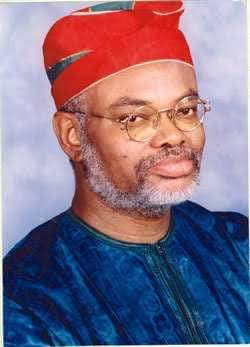
After 17 years in the civil service, Williams started his own business. He held directorships in several companies, including Julius Berger Nigeria Plc, Cappa and D’Alberto Plc, Ajaokuta Steel Company, and was Chairman of the Board of Directors of the National Maritime Authority.
Shortly afterwards, he left the private sector for the public service once again. This time, as a Commissioner in Lagos State under the military administration of Colonel Olagunsoye Oyinlola.
Funsho Williams’s Involvement in Nigerian Politics
When Funsho Williams decided to delve into Nigerian politics, he formed an alliance with the United Nigeria Congress Party (UNCP). However, after the queer and questionable death of General Sani Abacha, the party’s leader, he left and joined the Alliance for Democracy (AD) party.
Not long after, Williams decamped to the People’s Democratic Party (PDP), where he contested twice in the Lagos State Gubernatorial election. At the time of his death, Funsho Williams was most likely to be nominated as the PDP Gubernatorial candidate for Lagos State.
The Tragic Death of Funsho Williams
The 27th day of July 2006 was a sad day for Lagosians. Their favourite governorship candidate, Engineer Funsho Williams, had just been assassinated inside his study at his Dolphin Estate home in Ikoyi. The murder was said to have taken place at about 11:15 a.m. (WAT). His wife was away on a visit to London.
Professor John Obafunwa, the chief medical pathologist in the case, confirmed that Funsho Williams had died of strangulation. The post-mortem conducted on the body showed that the death resulted from asphyxia (lack of oxygen intake) due to “manual strangulation”. Funsho Williams was found with his hands tied and lying face down in a pool of blood on a dagger wrapped in a newspaper. It was a gruesome crime.
Six men, namely: Bulama Kolo, Musa Maina, David Cassidy, Tunani Sonani, Mustapha Kayode, and Okponwasa Imariabie, were arrested and tried in connection with the murder of the late politician. The defendants were first arraigned on March 1, 2013, on two counts of conspiracy and murder. After eight years behind bars, the suspects were all discharged and acquitted by Justice Ebenezer Adebajo of a Lagos High Court in Igbosere.[2]
The then national leader of the All Progressives Congress, Bola Ahmed Tinubu, was named the prime suspect in the murder after Bashir Junaid, a man initially detained for the murder, petitioned to have the case reopened to join him (Tinubu) as a party to the suit.[3] It was obvious that Funsho Williams and Bola Tinubu were rivals, and many fingers kept pointing to Tinubu as the brain box behind the murder. Even to this day, no other person has been arrested in connection with the murder.
All we are left with now are questions. Who killed Chief Bola Ige? Who Killed Funsho Williams? Will their killers ever be brought to justice? Let us know in the comments.
Want to understand what really happened during Nigeria’s first military coup? Read A Carnage Before Dawn. It offers a carefully researched, vividly told account of January 15, 1966, through a storytelling style that will keep you glued to the book’s pages.
You can get the e-book here and the paperback here.
Love history? Don’t stop here.
📚 Get deeper insights by purchasing our latest history books.
📢 Join our WhatsApp Channel for exclusive updates and historical facts.
📩 Subscribe to our Newsletter and receive fascinating stories from history (World and African history) directly in your inbox.
🎥 Subscribe to our YouTube channel for engaging documentaries and short history videos.
Stay connected with us on social media for daily history content:
🔵Follow us on Facebook.
📸 Follow us on Instagram.
🐦Follow us on Twitter.
💼 Follow us on LinkedIn.
🎵 Follow us on TikTok.
❤️ Support our work by donating to HistoryVille and help us continue preserving and sharing important historical stories. 📢Advertise with HistoryVille to reach a growing audience passionate about history and culture.
References
- [1] Adegoke, Blessing. The Act of Political Assassination in Nigeria. Munich: GRIN Verlag, 2010.
- [2] Opeseitan, Tayo. “Nigeria: Court Frees Funsho Williams’ Suspected Killers.” Daily Independent, June 30, 2014. https://allafrica.com/stories/201407010120.html.
- [3] Onyekwere, Joseph. “Ex-ACN Secretary Prays Court to Order Fresh Probe into Funsho Williams’ Death.” The Guardian Nigeria, February 9, 2015. https://guardian.ng/features/law/ex-acn-secretary-prays-court-to-order-fresh-probe-into-funsho-williams-death/.