
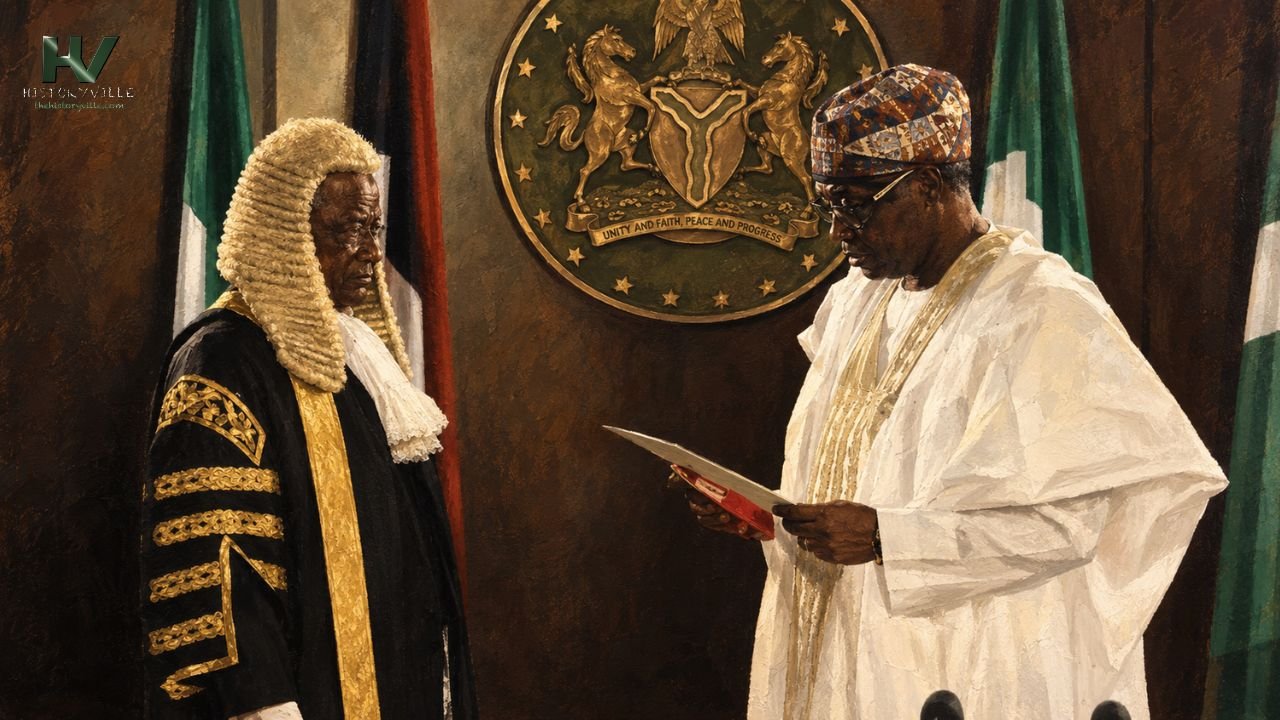

The emergence of Nigeria’s Third Republic was a more elaborate and deliberate affair than that of the First and Second Republics.
However, on November 17, 1993, General Sani Abacha, the Minister of Defence, took over from Chief Ernest Shonekan, the Head of the Interim National Government, who resigned, thereby unplugging the life support of the already dying Third Republic.
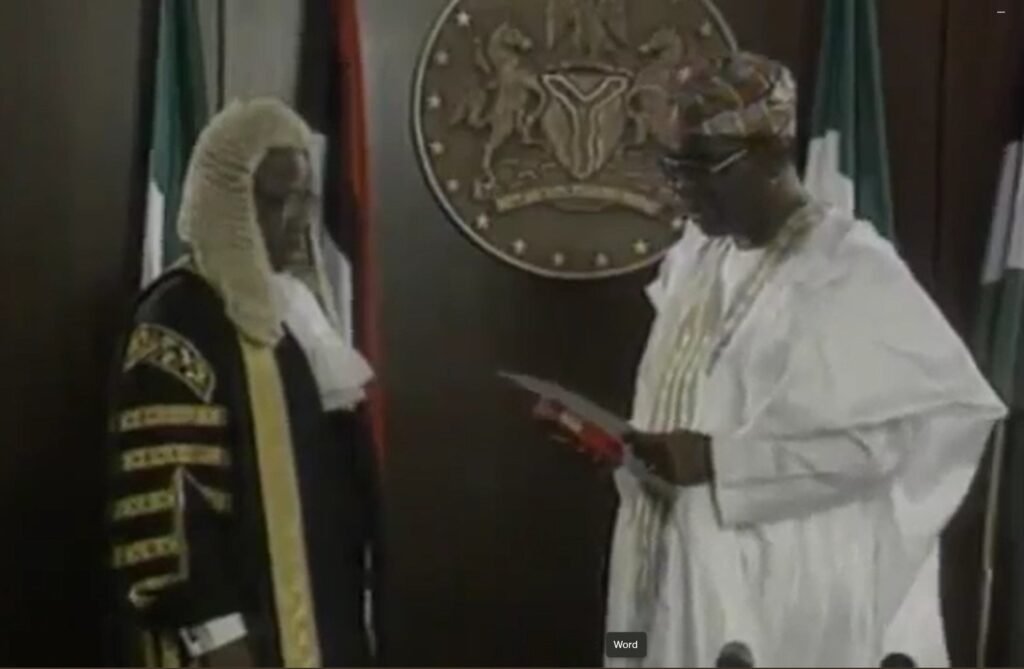
Abacha’s action halted the smooth transition from military to civilian rule.
Birth of Nigeria’s Third Republic (1985-1992)
After the Muhammadu Buhari military coup ended Nigeria’s Second Republic on December 31, 1983, it was inevitable that the 1979 constitution would be suspended.
After less than two years in power, Buhari was overthrown on August 27, 1985, by his Chief of Army Staff, Major-General Ibrahim Babangida, and in 1987, the 1979 constitution was reviewed. The reviewed constitution was approved by the Armed Forces Ruling Council (AFRC) in 1989.
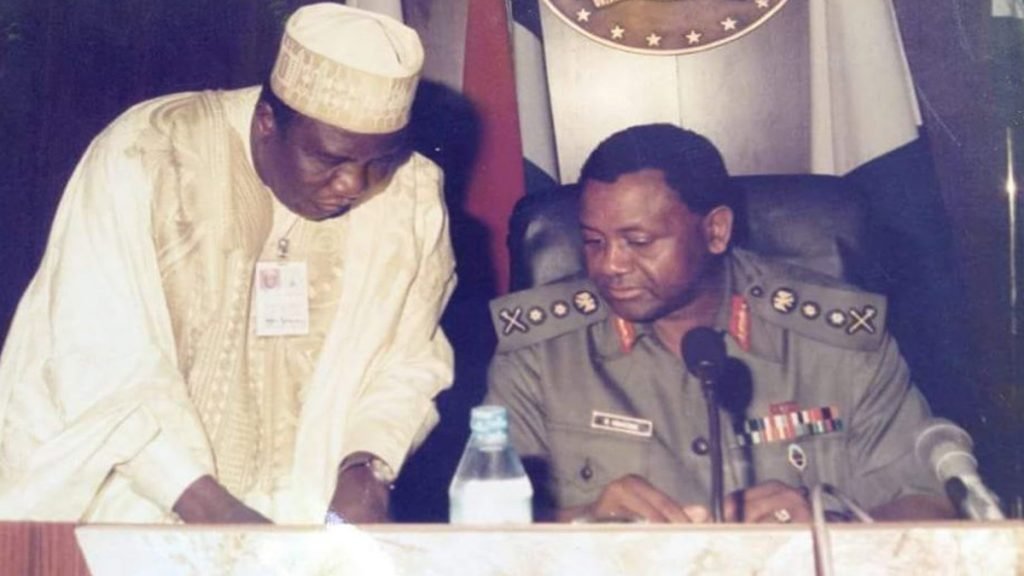
When Babangida came into power, his government began pursuing a twin “economic restructuring” programme and political transition. That is, from military rule to democratic rule to form Nigeria’s Third Republic.
Earlier, in 1985, the AFRC had set up a Political Bureau, made up of 17 members, in a bid to hand over power to a civilian government. The Bureau assessed Nigeria’s political history, identified pitfalls that led to the failure of the first two Republics and proffered strategies for the way forward for the Third Republic.
It then recommended to the AFRC that only two political parties be allowed in the Third Republic in order to ensure a political background built on ideology and principles and not ethnicity.
Before then, there were about 49 registered associations which were then condensed into two political parties. The parties were the National Republican Convention (NRC) and the Social Democratic Party (SDP).
After this modality was embraced by all and sundry, the next hurdle before the AFRC was the promulgation of programmes to accomplish the goal of democratic stability.
The objectives of the programmes include:
- Making laws to prevent anyone from hijacking the politics of the Third Republic.
- Ensuring that political parties and electioneering campaigns are duly funded by the state to relegate the role of private money in politics.
- Founding of state agencies such as the Centre for Democratic Studies (CDS) and Mass Mobilisation for Social and Economic Recovery (MAMSER) to teach, instil and influence democratic behaviour.
- Directly supervise the electoral process and smooth transition from military to civilian rule by the AFRC.
- Establish two grassroots political parties to allow for mass participation.
Based on these conditions, the two parties, NRC and SDP, got to work, canvassing for votes.
In 1991, the gubernatorial and state legislative elections for Nigeria’s Third Republic were held. The battle for political dominance between the NRC and SDP was fierce, so much so that both parties refused to participate legitimately in the final stages of the electoral process, which was surprising.
Against the backdrop of extreme cynicism and intra-party fracases, the federal legislative primary and the executive primary elections were held in 1992.
Prelude to the June 12, 1993, Presidential Election
The primary elections to determine who the flag bearers would be for each of the parties were rife with massive rigging. The contenders for the SDP were Olu Falae and Shehu Musa Yar’Adua, while the NRC had Adamu Ciroma and Umaru Shinkafi as contenders. They all wanted to win at whatever cost.
People’s votes were reportedly bought over with money, fertilisers, and even salt.
In September 1992, the presidential primaries were cancelled due to political anomalies and the parties were urged to try again. The date for the military abdication of power for a civilian President for the Third Republic was also deferred.
The National Electoral Commission (NEC) adopted the open-ballot system whereby electorates queued in front of a portrait of their chosen contestant and would be counted by the electoral officers. The motive was to frustrate the efforts of unscrupulous politicians who wanted to perpetuate fraudulent practices at the election site. It also meant everything was done in the open and everyone could see how the counting was done so that the results would be accurate.
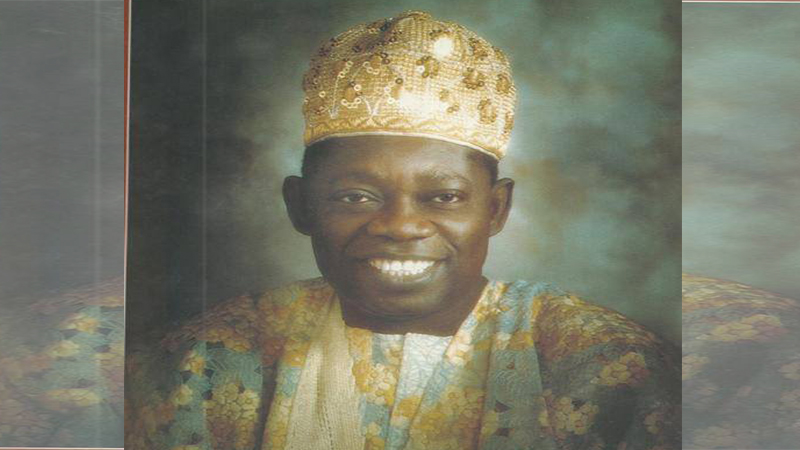
While the Chairman of the SDP, Baba Gana Kingibe, welcomed this new system of voting, stating that the open ballot system would in a short while constitute Africa’s major contribution to democracy, the NRC took a dim view of the new electoral process. Instead, the party opted for a modification of the procedure, suggesting an “open-secret” ballot system.
The difference here was that the thumb printing and sealing of the ballot paper would be done in secret, but the voter would drop the paper in a box placed outside for all to see.
Alas, this strategy did not hold sway during the Presidential primaries and with the NEC determined to resolve this issue before June 12, 1993, which was the date set for the Presidential elections, another approach dubbed “Option 4” was concocted.

Here, each state of the Federation would elect two presidential candidates from both parties and would converge at a national convention of both parties where voting would be done to determine each party’s flag bearer.
The National Conventions were held from March 27 through 29, 1993. That of the NRC was held in Port Harcourt, Rivers State, and Bashir Tofa emerged as the party’s presidential candidate.
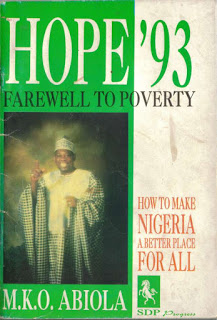
Meanwhile, the SDP convened in Jos, Plateau State and Moshood Abiola scaled through to become the party’s flag bearer. It was, however, a close call between him and Baba Gana Kingibe.
At the time, it was a political relief as both contenders received full support from their parties without any squabbles. The process was done orderly, and those who lost were magnanimous in defeat.
Option 4 was indeed a success and was like a stepping stone, mirroring what the main elections would look like, which was a free, fair and rigging-free election.
A decree titled Presidential Election (Basic Constitution) and Provision Decree 13 was promulgated to stimulate the electoral process. The decree stated that presidential candidates could be disqualified if fresh evidence was discovered, implicating them in legal and political culpability in the past.

Section 54, subsection 1 of the decree stated that where a date has been appointed for holding of an election, and there is reason to apprehend that a serious breach of the peace is likely to occur if the election is proceeded with on that day, the election may be postponed by the Commission until some convenient day.
To emphasise some more on the decree, the NEC reiterated the tenets of Decree 27 of 1989 which stipulates, inter alia, that no political campaign shall be made on the basis of sectional, ethnic or religious grounds or consideration… This was to prevent electoral violence.
Emphatically, the NEC affirmed that the presidential election to usher in the Third Republic would be held irrespective of any hindrance on June 12, 1993, and not be deferred.
The Annulled June 12, 1993, Presidential Election
The presidential election which took place on June 12, 1993, will remain a significant milestone in Nigeria’s political history due to the peaceful conduct of the elections.
The presidential and vice-presidential candidates for the SDP were Moshood Abiola and Baba Gana Kingibe, while those of the NRC were Bashir Tofa and Sylvester Ugoh.

At the end of the voting process, the SDP won in 19 states while the NRC won in 11 states.
The turnout for the June 12, 1993, presidential election was lower than what was expected, and this could be attributed to the confusion brought about by the Association for a Better Nigeria (ABN). The ABN had sought a court injunction to postpone the election, citing alleged malpractices by both parties as their reason.
In spite of the presumed orderliness of the June 12 election and the legitimisation of the process by both national and international observers, the head of state, General Ibrahim Babangida, still went ahead to annul the election. As a result, Nigeria’s Third Republic was on a life-support machine.
While addressing the nation on June 26, 1993, Babangida explained that some causes that led to the annulment of the election were:
- Allegations of irregularities by presidential candidates which the NEC overlooked.
- Evidence of widespread bribery during party primaries as well as the election.
- Cases of documented and confirmed conflict of interest between the government and both aspirants, thereby compromising their positions and responsibilities should they become the President.
In light of the above reasons, another presidential election was called for by the National Defence and Security Council, which would be supervised by the National Electoral Commission.
The aftermath of June 12 and the end of Nigeria’s Third Republic
A national protest erupted across Nigeria, condemning the annulment of an election that was adjudged the freest and fairest election ever conducted in the country. General Babangida was forced to step aside and, on August 26, 1993, he stylishly handed over power to Chief Ernest Shonekan, who became the head of an Interim National Government (ING), in a quest to save the dying Third Republic.

83 days later, on November 17, 1993, General Sani Abacha forced Shonekan to resign in a palace coup and overthrew the ING. The next day, November 18, 1993, Abacha made his maiden broadcast to the nation and formally dissolved whatever was left of the ING, effectively burying Nigeria’s Third Republic.
As expected, Abiola rallied his supporters to retrieve his stolen mandate, as it were, and formed the National Democratic Coalition (NADECO) on May 15, 1994, calling on General Abacha to step down for him.
Abacha’s response was to arrest Abiola for treason and a crackdown on NADECO members and anyone who sympathised with Abiola. General Sani Abacha allegedly plotted the state killings of Pa Alfred Rewane and Kudirat Abiola, one of Chief Abiola’s wives. She was felled by assassins’ bullets while fighting for the release and mandate of her husband, who had been imprisoned by Abacha.
When Abacha died suddenly on June 8, 1998, the news was met with jubilation among many Nigerians who heaved a sigh of relief that Abiola would finally become the President. However, about 30 days later, on July 7, 1998, Abiola also died under mysterious circumstances – the same way Abacha died.
After Abacha’s death, Major-General Abdulsalami Abubakar, the Chief of Defence Staff, was sworn in as the 11th Nigerian head of state on June 9, 1998. That ceremony marked the end of the Abacha regime and another journey to democracy, which would lead to Nigeria’s Fourth Republic with the swearing-in of Olusegun Obasanjo on May 29, 1999.
Want to understand what really happened during Nigeria’s first military coup? Read A Carnage Before Dawn. It offers a carefully researched, vividly told account of January 15, 1966, through a storytelling style that will keep you glued to the book’s pages.
You can get the e-book here and the paperback here.
Love history? Don’t stop here.
📚 Get deeper insights by purchasing our latest history books.
📢 Join our WhatsApp Channel for exclusive updates and historical facts.
📩 Subscribe to our Newsletter and receive fascinating stories from history (World and African history) directly in your inbox.
🎥 Subscribe to our YouTube channel for engaging documentaries and short history videos.
Stay connected with us on social media for daily history content:
🔵Follow us on Facebook.
📸 Follow us on Instagram.
🐦Follow us on Twitter.
💼 Follow us on LinkedIn.
🎵 Follow us on TikTok.
❤️ Support our work by donating to HistoryVille and help us continue preserving and sharing important historical stories. 📢Advertise with HistoryVille to reach a growing audience passionate about history and culture.